
The dramatic decline in the starling population rings alarms bells. A once common bird, with their stunning murmurations as seen in image 2, the population is now plummeting. But what has caused that drop? A look into wastewater shows a startling answer to this. Wastewater is a hazard of civilization. What goes through the human body is found in the treatment plants. Cities produce it in endless supply. Wastewater analysis offers foresight into an increase of problems in both disease and drug use.
What is Waste Water?
In the West, we have safe drinking water straight from the taps. Not only for drinking, we use it to wash our hands, wash dishes, clean our teeth, and for cooking. However, domestic situations aren’t the only high users of water, both commerce and Industry use this clean water along with agriculture. The United States has the highest water usage per person among the developed countries (Otto, 2020).

Credit: Public domain
Everything that spirals down the drain after use is considered wastewater. In some places, this ‘grey water’ is used for flushing toilets, in other places, the toilet is flushed with fresh water. However it gets there, all of this water ends up in the sewer system. It all ends up at a treatment plant like the one in Image 1. The contents of the sewer consist of approximately 99.9% water. The other 0.01% needs to be removed during treatment before the cleaned water can be returned to nature (Tuser, 2021).
Why Do We Treat Waste Water?
Historically, the River Thames in London UK, was used as a dumping ground for all the filth the city produced. In 1858, the Thames was so full of effluent that the summer of that year was called The Great Stink. The Members of Parliament in Westminster Palace were driven from their seats by the foulness. The formation of the great sewer system under London, incorporating the ancient tributaries of the Thames into tunnels, was the solution. This system directed the waste away from the City (Lemon, 2024).
Before this in 1854, an outbreak of the disease Cholera was halted in its tracks by removing the handle from a water pump. People suffering from the disease got their water either from the filthy river or from a pump on Broad Street. People nearby. who took their water from the Thames above the contamination, remained clear of illness. Neatly proving that Cholera was transmitted by tainted water (Tulchinsky, 2018).
In both these cases, treating the water solved the problem. This is why in modern times, all our drinking water is treated to the highest standards.
What has all this got to do with Starlings?
In 2015, a paper was published by researchers at the University of York in the UK, about the decrease in Starling populations. The birds ate worms from the settling tanks at wastewater treatment plants. In recent years, the use of anti-depressants such as Prozac has increased.
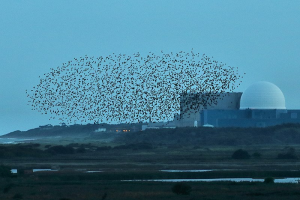
Credit: https://commons.wikimedia.org/wiki/File:Starling_Murmuration_(22224258175).jpg
Urine and faeces are the most common ways for a body to eliminate drugs and these drugs pass into the wastewater. Worms in the settling tanks contained these drugs and the starlings were eating them. These drugged-up starlings sat around, not bothering to eat as much as regular birds. Without those extra calories, they were less likely to survive the winter, causing a drop in the numbers (Arnold, 2015). It’s not just starlings, fish and other animals that drink from the rivers are affected by the drugs that humans are releasing into the water supply. And this is also the water humans drink. So now, perhaps, you begin to see the need for wastewater analysis.
What Are We Testing for?
As you saw above, the wastewater treatments fail to remove even prescription drugs from the water pumped into the rivers. It is vital to learn what is in the water we drink, so analysing random samples gives much-needed information about the purity of the water we drink.
Water Quality
Freely running water should have plenty of oxygen which allows microorganisms to aerobically digest organic matter. If too much sediment halts the flow, then the oxygen is used up, and anaerobic bacteria start working on the sediment. These microorganisms allow the water to stagnate, releasing poisonous, hydrogen sulphide gas and other unwelcome substances, such as methane and carbon dioxide.
In addition to sediment, indust

Credit: Public domain.
waterborne, therefore analysing for illness is an important part of control. Most recently, in London in the UK, they have discovered poliovirus. The disease is considered nearly extinct in this population. The finding is alarming as Polio is transmitted through water (Gov.uk, 2022). In the recent SARS-COV-2 outbreak, it was possible to track an imminent rise in cases by a pre-rise increase of the virus in wastewater (NWSS, 2024).
If water remains untreated then other illnesses, such as ecoli, end up in shellfish and other aquatic life, rendering them unfit for consumption. Essential testing for microorganisms prevents outbreaks of illness (Tuser, 2021).
Illicit Drug Use
Finally, all this leads to the Forensic Science. With proper wastewater analysis, it is possible to track drug usage by testing the wastewater in cities. Like the anti-depressants affecting wildlife, illicit drugs travel through the body and are released into the water supply. However, the use of cocaine and cannabis is tracked through metabolites rather than the actual drug. Usage of cocaine sees a rise in benzoylecgonine. For cannabis, the rise is in the tetrahydrocannabinol, THC-COOH.
The Sewage Analysis CORe group – Europe (SCORE) began testing wastewater in 2011. At first drug use showed stable consumption, but in 2016 a rapid increase was observed. In the spring of 2023, The group took samples of wastewater for a week in 88 European cities. Spain, Belgium, and the Netherlands show high usage of cocaine. While in Spain, they are less likely to use amphetamine. Overall, Western and Southern European countries showed the most active drug use. Interestingly, as the samples were taken over a week, the researchers tracked the rise and fall of usage. Cannabis and methamphetamine were used steadily over the week, while three-quarters of the cities showed an increase in cocaine, amphetamine, MDMA, and ketamine at the weekend. Multiple locations in each country were sampled. Surprisingly, smaller locations showed the same volume of drug use as the larger cities (EMCDDA, 2024).
Conclusion
Civilization is a filthy thing. All those humans gathered together fill the rivers with wastewater. Initially, Waste Water analysis and treatment was to prevent disease. More recently, researchers have discovered it is possible to track the usage of illicit drugs. If anti-depressants in the water supply can harm wildlife, what is the upsurge of illicit psychoactive drugs doing to nature? Wastewater analysis can help formulate new methods of removing these harmful substances from the natural water supply. In turn, this will allow nature to heal the fish and birds. Not only that, humans benefit from clean, clear water.
References
Arnold, K. (2015) Could Prozac be Killing off our Starlings? University of York. January 6. https://www.york.ac.uk/research/themes/prozac-and-starlings/#:~:text=Dr%20Arnold%20added%3A%20″Our%20research,a%20reduction%20in%20starling%20numbers
EMCDDA. (2024) Wastewater analysis and drugs — a European multi-city study. European Monitoring Centre from Drugs and Drug Addiction. March 20. https://www.emcdda.europa.eu/publications/html/pods/waste-water-analysis_en
Gov.UK. (2022). Poliovirus Detected in Sewage from North and East London. UK Health Security Agency. June 22. https://www.gov.uk/government/news/poliovirus-detected-in-sewage-from-north-and-east-london#:~:text=As%20part%20of%20routine%20surveillance,that%20were%20not%20detected%20again
Lemon, J. (2024) The Great Stink. City of Westminster Archives. https://www.choleraandthethames.co.uk/cholera-in-london/the-great-stink/
NWSS. (2024) About Wastewater Data. Centers for Disease Control and Prevention. January 5. https://www.cdc.gov/nwss/about-data.html#:~:text=Wastewater%20monitoring%20can%20detect%20viruses,also%20detect%20infections%20without%20symptoms
Otto, B. and Schleifer, L. (2020). Domestic Water Use Grew 600% Over The Last 50 Years. World Resources Institute. February 10. https://www.wri.org/insights/domestic-water-use-grew-600-over-past-50-years
Tulchinsky T. H. (2018). John Snow, Cholera, the Broad Street Pump; Waterborne Diseases Then and Now. Case Studies in Public Health, 77–99. https://doi.org/10.1016/B978-0-12-804571-8.00017-2
Tuser, C. (2021). What is Waste Water? Wastewater Digest. December 1. https://www.wwdmag.com/wastewater-treatment/article/10938418/what-is-wastewater


