In May 2024, New Scientist magazine reported on the facial reconstruction of a 75,000-year-old Neanderthal woman (George, 2024). Because her remains were discovered in the Shanidar cave in Iraq, she was named Shanidar Z. This amazing combination of art and science started as crushed bones, flattened by millennia of earth pushing down on them. By borrowed these techniques from Archaeology, forensic facial reconstruction is utilized by forensic scientists to identify more recent skeletal human remains.
What is facial reconstruction?
Credit: https://www.usg.edu/teaching-and-learning-excellence/assets/facultydevelopment/documents/ebook/MarriottClark.pdf
To perform Facial Reconstruction, a practitioner will combine anatomy, osteology, and a certain degree of creativity, to make a reasonable facsimile of an individual’s face from nothing but their skeletal remains. Often used in missing person cases, it remains a controversial technique, even though several people have recognized their missing family members from an artistic reconstruction (Houlton, 2024).
History of Facial Reconstruction
The purpose of forensic facial reconstruction is to create an image so that an unidentified individual might be recognized. The discipline has developed over the last 100 years into an anatomy-based artistic study. The most important qualification for this field is skill in sculpture or drawing, along with endless practice (Missal, 2023). An early anatomist, Welker, compared the skull of the artist Raphael with a self-portrait, and the skull of the philosopher Kant with his death mask. From these, Welker worked out the thickness of the facial tissues.
Moving on to 1908, a Neanderthal skull was discovered in a cave in France. Several anatomists from various countries attempted to reconstruct the face. However, each anatomist’s attempt was different from the others. One example is shown in image 2.

It took until 1916 until the first forensic reconstruction took place (Verzé, 2009).
Case study 1
The place is New York, USA. The year is 1916. Bones found in a Brooklyn cellar are believed to be of a person of Italian extraction. Using newspaper and plasticine, a face is created for the individual. Locals identified the sculpture as Domenico La Rosa, who had disappeared. Although the face was thinner than the living person, the image was recognizable. This was the first use of facial reconstruction to resolve a crime (Verzé, 2009).
It is generally considered that the identification in La Rosa case was chance, but the techniques were refined over the next twenty years by Mikhail Girasimov. He applied his interest in archaeology and paleontology to forensic science to create a reproducible technique of turning a skull into a face. His method came to be known as The Russian Technique and used the traces of the musculature left on the bones to apply an underlying set of muscles, and overlaying it with a skin layer. However, another method termed The American Technique carefully measured the thickness of tissues above the skull, and relied on depth pins to produce an underlying structure, before adding the skin layer. In 1984, the UK Manchester Method combined the two processes, to create the most accurate to date facial reconstructions (Verzé, 2009).
Of course, in the C21st facial reconstruction is performed by 3-D modelling software on computers (Verzé, 2009).
How is facial reconstruction performed?
A facial reconstruction is never performed on the actual skull. As with all primary evidence, it needs to be preserved in case additional tests and analysis are required. After other tests, to determine, what the sex of the skeleton is, an approximate age, and possible area of origin, the first step of facial reconstruction is always to create a cast of the skull. Eyes and an estimate of the cartilage of the nose come next (Brianaala, 2013).
Credit: (Davies, 2020)
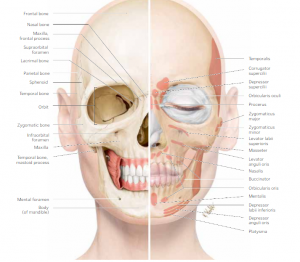
Using the UK Manchester Method, the next step requires depth pegs to be glued to the appropriate spots as shown in Image 3. The tissue depth follows the guidelines set out nearly 100 years ago, as mentioned in The American Technique (Future Learn). With the pegs in place, facsimile muscles of clay are attached to the model, as in The Russian Technique.
With the muscles in place, a neck can be added to the sculpture. Skin is laid on top and ears are estimated. Hair, in keeping with racial characteristics is added, and finally, if any items of jewelry or clothing were found with the body, copies of those are added to the model. With luck, the model will remind a witness, and give the missing person a name (Brianaala, 2013).
Case Study 2
A Chicago alley in 2007 hid a grisly secret. A cardboard box full of human remains. Too decomposed to identify, the police named the woman the Chicago Jane Doe. A Forensic Artist reconstructed the woman’s face, including her hair in a ponytail, because an elastic band was found with her, and a tooth with a distinctive chip. They published the image in the Illinois Dental News. A receptionist at a local clinic remembered the woman and gave her back her name: Marlaina Reed (Jones, 2022).
Often, when a person is identified, it finally gives their family closure over their disappearance.
Case Study 3
In 1982, in Twinsburg, Ohio, human remains were found in plastic bags near an abandoned factory. Analysis confirmed that they belonged to an African-American man. With no further evidence available, the man was called the Twinsburg John Doe and the case went cold. But in 2016, a Forensic Artist created a reconstruction of the man’s face. The man was found to be a former soldier and R&B singer from the band the O’Jays. No one in his family had heard from him since the mid-1970s (Jones, 2022).
Conclusion
The process of forensic facial reconstruction takes time and patience. The techniques have come a long way from the 1908 image of a hairy ape-like Neanderthal to the 2024 image of a Neanderthal woman, you would not look twice at in the street. Some people consider the method more luck than skill when a match is achieved. However, where a missing person is identified, photographs of the person are uncannily similar to the sculpture. Each time human remains are identified it brings their families closer to an answer of why they went missing.
References
Brianaala in Circuits. (2013). How to do a Forensic Facial Reconstruction. AutoDesk Instructibles. https://www.instructables.com/How-to-do-a-Forensic-Facial-Reconstruction/
Davies, C and Miron, R. (2020). Facial Anatomy, Skin Biology, and the Effects of Aging. https://www.researchgate.net/publication/366905779_Facial_Anatomy_Skin_Biology_and_the_Effects_of_Aging
Future Learn. Preparation and Tissue Depth. University of Sheffield. https://www.futurelearn.com/info/courses/forensic-facial-reconstruction/0/steps/31185#:~:text=To%20preserve%20the%20original%20skull,reproduction%20of%20the%20original%20skull
George, A. (2024). Astonishing images show how female Neanderthal may have looked. New Scientist. 2 May. https://www.newscientist.com/article/2429497-astonishing-images-show-how-female-neanderthal-may-have-looked/
Jones, A. (2022). 10 Faces of the Dead Rebuilt by Forensic Artists. List Verse. April 7. https://listverse.com/2022/04/07/10-faces-of-the-dead-rebuilt-by-forensic-artists/
Houlton, T. (2024). Facing Our Past with Facial Reconstruction. Digitscotland.com. https://www.digitscotland.com/facing-our-past-with-facial-reconstruction/
Missal, S. (2023). Forensic Genetic Approaches for Identification of Human Skeletal Remains. Ambers, A (ed) Chapter 24 – Forensic facial reconstruction of skeletonized and highly decomposed human remains. (pp 549-569) Academic Press. https://www.sciencedirect.com/topics/medicine-and-dentistry/forensic-facial-reconstruction#:~:text=Forensic%20facial%20reconstruction%20is%20a,drawing%20of%20the%20deceased%20subject.
Verzé, L. (2009). History of facial reconstruction. Acta bio-medica : Atenei Parmensis. 80. 5-12. https://www.researchgate.net/publication/26765706_History_of_facial_reconstruction