Legends have lengthy traced Nalanda’s origins to the Buddha himself. One that Xuanzang recorded withinside the 7th century CE speaks of a naga (serpent) named “Nalanda” who as soon as lived in a pond in a mango grove, later the website online of the Mahavihara. “Five hundred merchants,” he adds, “bought [the mango grove] for ten kotis of gold portions and gave it to the Buddha,” who preached the regulation right here for three months. From then on, it has become a domain of coaching and learning, and even Nagarjuna, the main parent of Mahayana Buddhism and a “2nd Buddha” to some, turned into stated to have taught right here withinside the 2nd century CE (even though evidence for that is scant).

When Faxian surpassed via the adjoining “village of Nala” in c 407 CE, he mentioned a stupa with relics of Sariputra, one of the closest disciples of the Buddha (Sankalia et al., 1934). Oddly, no network of clergymen had grown across the relics of a parent as eminent as Sariputra. Faxian did now no longer mention such a network. It’s consequently affordable to finish that there has been no monastery at Nalanda while Faxian visited withinside the early 5th century CE.
Our know-how of Nalanda comes from 3 forms of number one sources: Archaeology, epigraphy (the look at of inscriptions) and texts that survived in overseas lands after Buddhism and its texts disappeared from India with the aid of using the mid-2nd millennium. Nalanda Mahavihara likely arose some years after Faxian’s visit – at some point of the reign of Kumaragupta (reigned c 414-fifty five CE) – and lasted around 8 centuries. The site’s legendary hyperlinks with excellent names may also nicely have fashioned the selection to discover the monastery there (Pinkney et al., 2015).
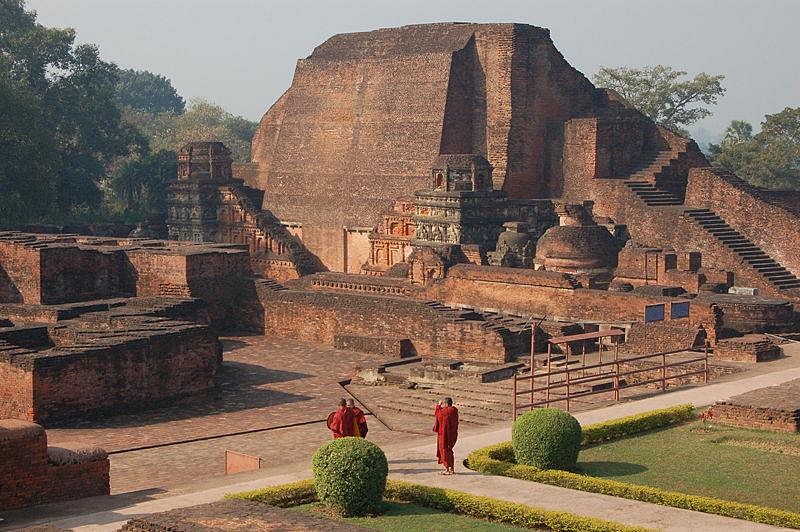
Their paintings exposed 11 monasteries, six temples and a massive stupa, aka the Great Monument. The monasteries, specified in a row, face a parallel row of temples immediately across. A 30-meters-extensive course runs among the 2 rows. Each monastery, averaging approximately 40m x 60m, is made from rectangular pink bricks, once plastered with a paste of lime and sand. In Yijing’s time, there have been seven monasteries, all “very comparable in fashionable look and layout; in case you see one, you’ve got visible all of the seven”.
Parts of the courtyard flooring that aren’t brick or stone are daubed with an aggregate of dried cow dung and straw, which offers termite repulsion, thermal insulation and a cleaner, more impregnable floor than mud. All rooms withinside the monastery have walls that are more than one ft thick. Teachers and college students stay collectively withinside the monastery; every 12 months earlier than the monsoon, the eldest clergymen are given the nice rooms. Monks education to end up temple, monks get a room with a purpose-built area of interest for a holy picture, to which they provide flora and incense after bathing every morning.

Rooms host both one or clergymen and feature timber doors. The clergymen take a seat down on easy chairs, wooden blocks or small mats. Each morning, the clergymen roll up their mattresses – sewn sheets of material with a layer of wool in between. Pillows are crammed with “home products, together with wool, hemp-scraps, the pollen of Typha latifolia, the catkins of the willow, cotton, reed, Tecoma Grandiflora, tender leaves, dry moths, the ear-shells, hemp or beans”. The clergymen save books and utensils in niches reduce into the thick walls.
At its base can also additionally had been the well-known library of Nalanda, even though a Tibetan supply speaks of a library with 9 storeys, which appears incredible for the constructing era of the day. In any case, the library’s vicinity stays uncertain. It held the types of manuscripts that the Chinese pilgrims got here in seek of (at the least 8 finely illustrated palm-leaf manuscripts created at Nalanda all through the Pala period nonetheless survive (Rajani et al., 2016)).
Nalanda became an area for superior learning, now no longer fundamental training. Aspiring college students needed to be at least two decades antique and by skipping an oral examination on the monastery’s entrance. They needed to “display their cap potential with the aid of using difficult discussion” and exhibit a deep knowledge of “each antique and new books earlier than getting admission”. No greater than or three out of ten have been admitted, or even they have been right away humbled with the aid of using the calibre of their instructors and co-college students. Nuns have been admitted too however little document of their lives survives.
Sources
Sankalia, H. D. (1934). University of Nalanda. BG Paul and Company, Madras.
Pinkney, A. M. (2015). Looking West to India: Asian education, intra-Asian renaissance, and the Nalanda revival. Modern Asian Studies, 111-149.
Rajani, M. B. (2016). The expanse of archaeological remains at Nalanda: a study using remote sensing and GIS. Archives of Asian Art, 66(1), 1-23.