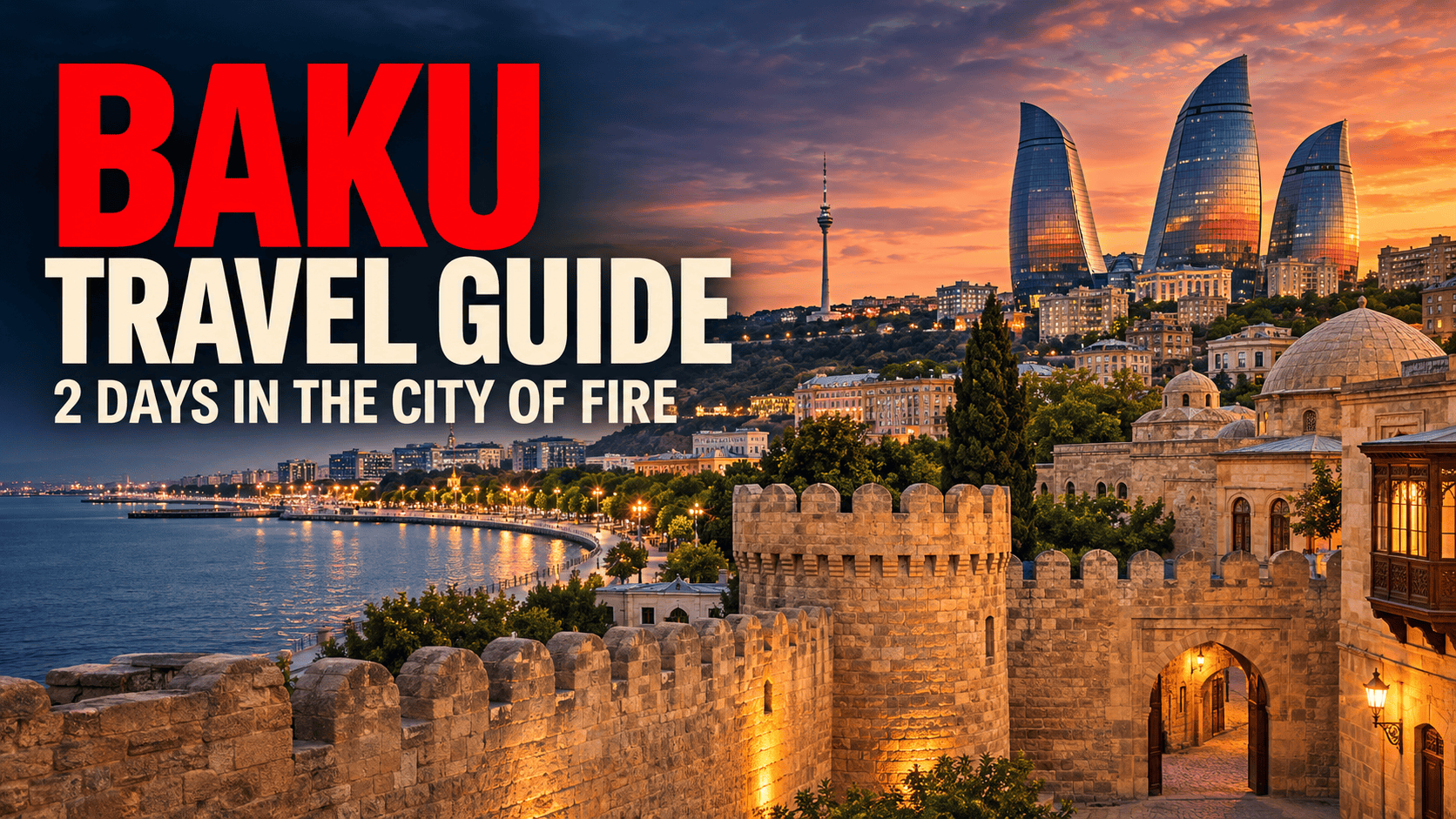
Before arriving in Baku, I had two very different images of the city in my mind.
The first was a modern capital of glass towers, ambitious architecture and wide boulevards overlooking the Caspian Sea. The second was an older city of stone walls, caravanserais, palaces and narrow streets shaped by centuries of movement between the Caucasus, Persia, Russia and Central Asia.
Once I arrived, I realised that these two versions of Baku were not competing with each other.
The real character of the city comes from the way they exist side by side.
You can spend the morning walking through the medieval streets of Icherisheher, see the architectural traces of the oil boom and Soviet period in the afternoon, and finish the day in front of Zaha Hadid’s futuristic Heydar Aliyev Center.
I spent two nights in Baku and stayed at Radisson Hotel Baku as part of a content collaboration. Its central waterfront location made it easy to connect the Old City, Baku Boulevard and Nizami Street within the same route.
Two days were enough for the main sights and a short journey to Ateshgah and Yanardag. However, three or four days would be more comfortable if you also want to visit museums, Gobustan and less-touristic neighbourhoods.
This Baku travel guide covers the best things to do, a practical two-day itinerary, local food, transportation and my experience at Radisson Hotel Baku.
What is Baku like?
Baku is not a city that can be explained through a single architectural style or historical period.
Icherisheher represents its medieval core. The ornate buildings surrounding the city centre reflect the wealth created by the nineteenth-century oil boom. Soviet structures introduce a heavier architectural language, while the Flame Towers and Heydar Aliyev Center express modern Azerbaijan’s desire to present itself as an ambitious global capital.
Walking through Baku can therefore feel like moving between several different cities.
The contrasts are visible everywhere: old stone walls and illuminated skyscrapers, traditional tea houses and luxury boutiques, quiet courtyards and broad avenues.
Many central attractions can be explored on foot. Icherisheher, Nizami Street, Fountains Square and Baku Boulevard can easily be combined in one day.
Ateshgah, Yanardag and Gobustan are outside the centre and require public transport, a private driver or an organised tour.
Best things to do in Baku
Explore Icherisheher, Baku’s Old City
Icherisheher is the best place to begin exploring Baku.
The walled Old City feels like a separate world within the modern capital. Its narrow streets lead between traditional houses, former caravanserais, small workshops, restaurants and historic religious buildings.
Its appeal is not limited to individual monuments. The street plan, stone passages and hidden courtyards are part of the experience.
Icherisheher, together with the Maiden Tower and Palace of the Shirvanshahs, is recognised as a UNESCO World Heritage Site. The area reflects layers of Zoroastrian, Sasanian, Arabic, Persian, Shirvani, Ottoman and Russian influence.
Arrive early if you want to experience the streets before the busiest part of the day. Return after dark if possible, as the lighting creates a noticeably different atmosphere.
See the Maiden Tower
The Maiden Tower is one of Baku’s most recognisable landmarks.
Its exact age and original function remain subjects of discussion, which has contributed to the legends surrounding the structure.
The area around the tower becomes busy during the day. Morning is better for seeing its exterior without large crowds.
If you plan to enter and climb the tower, confirm the current opening hours and ticket information on the day of your visit.
Visit the Palace of the Shirvanshahs
Located at one of the highest points in Icherisheher, the Palace of the Shirvanshahs is essential for understanding Baku’s historical identity.
The complex contains palace buildings, tombs, a mosque, bathhouse remains and ceremonial spaces. Take time to examine the stonework rather than treating it as a quick photo stop.
UNESCO describes the palace complex, developed between the twelfth and fifteenth centuries, as one of the important examples of Azerbaijani architecture.
Walk along Baku Boulevard
Baku Boulevard stretches along the Caspian Sea and offers a calmer alternative to the busy city centre.
Its wide promenade, parks and waterfront views make it particularly enjoyable in the evening. After several hours inside the Old City, walking along the coast provides a natural change of pace.
Baku is often called the City of Winds, and the name becomes easier to understand along the waterfront. Even on a warm day, carrying a light extra layer can be useful.
See the Flame Towers
The Flame Towers are among the most familiar symbols of modern Baku.
Visible from different parts of the city, the three towers provide a contemporary interpretation of Azerbaijan’s historic association with fire.
You do not necessarily need to enter the buildings. Baku Boulevard, the edge of Icherisheher and Highland Park offer stronger views of the towers as part of the wider skyline.
The buildings become especially prominent after sunset, when their illuminated façades transform the appearance of the city.
Watch the sunset from Highland Park
Highland Park offers one of the best panoramic views in Baku.
From here, you can see the Caspian Sea, the waterfront, the city centre and the expanding modern skyline within a single landscape.
Arrive shortly before sunset. This allows you to see Baku in daylight and then watch the city lights gradually appear.
It is also a useful place to understand the scale of the capital after spending the day within the compact streets of the Old City.
Walk along Nizami Street and Fountains Square
Nizami Street is one of Baku’s liveliest pedestrian areas.
Shops, cafés, restaurants and ornate historic façades line the street, while nearby Fountains Square functions as an important social meeting point.
The district is commercial and popular with visitors, but it still provides a good place to observe contemporary city life.
Walk beyond the main pedestrian section as well. The surrounding streets contain some of the clearest examples of the architecture created during Baku’s oil-boom period.
Visit the Heydar Aliyev Center
The Heydar Aliyev Center represents a very different side of Baku.
Designed by Zaha Hadid and opened in 2012, the building is known for its flowing white surfaces and absence of conventional sharp angles. Its permanent collections include an exhibition about Heydar Aliyev, miniature versions of Azerbaijani landmarks and a collection of classic cars.
Even if you do not visit the exhibitions, the exterior is worth seeing.
Walk around the building rather than photographing it from only one angle. The curves and shadows change significantly depending on your position and the light.
Discover Ateshgah Fire Temple
Ateshgah is one of the most important cultural sites outside central Baku.
Located on the Absheron Peninsula, the temple complex is connected to the region’s natural gas deposits and historic relationship with fire. The existing structure was particularly influenced by Indian merchants and pilgrims who visited the area during the seventeenth and eighteenth centuries.
Ateshgah should not be viewed simply as a place with a flame at its centre.
It provides context for Azerbaijan’s identity as the Land of Fire and demonstrates how natural phenomena can influence religion, trade and cultural memory.
See the natural flames at Yanardag
Yanardag is known for the natural flames created by underground gas reaching the surface.
The burning section may appear smaller than expected if you have only seen carefully framed photographs online. Its importance lies less in its size and more in what it reveals about the geology and fire culture of the Absheron Peninsula.
Ateshgah and Yanardag should be combined into the same half-day journey rather than visited separately.
If your time is limited, an organised tour or private driver is more efficient than navigating several public transport connections.
Consider a day trip to Gobustan
If you have a third or fourth day in Baku, consider adding Gobustan to your itinerary.
The region is known for its prehistoric rock art and unusual surrounding landscapes. Because it is outside the city, transportation should be arranged in advance.
For a short two-day visit, I would prioritise Ateshgah and Yanardag. For a longer journey, Gobustan adds a valuable archaeological and natural dimension to the experience.
A two-day Baku itinerary
Day one: The Old City and modern skyline
Begin the morning in Icherisheher.
Allow at least three hours for the Maiden Tower, Palace of the Shirvanshahs and the surrounding streets. Continue towards Nizami Street and Fountains Square for lunch.
In the afternoon, walk along Baku Boulevard before heading to Highland Park shortly before sunset.
End the day with views of the illuminated Flame Towers and dinner near Nizami Street or the Old City.
Day two: Ateshgah, Yanardag and modern architecture
Travel to Ateshgah in the morning and continue to Yanardag.
Including transportation, allow approximately half a day for the two sites.
Return to central Baku and spend the afternoon at the Heydar Aliyev Center. If you still have energy in the evening, return to Icherisheher to see the Old City after dark.
You can compare Baku tours and cultural experiences through GetYourGuide. Use MOZARTCULTURESTR5 for 5% off eligible activities.
How many days do you need in Baku?
The ideal duration depends on your travel style.
Two days: Enough for the Old City, central Baku, Ateshgah and Yanardag, but the schedule will be busy.
Three days: More comfortable for museums, modern architecture and slower exploration.
Four days: Allows time for Gobustan or additional locations around the Absheron Peninsula.
I spent two nights in Baku. It worked for a short and carefully planned itinerary, but I would add another day next time to explore Icherisheher more slowly and visit Gobustan.
Where to stay in Baku
For a first visit, the areas around Icherisheher, Sahil, Nizami Street and Baku Boulevard are the most practical.
Staying centrally allows you to reach several attractions on foot and return to your hotel without relying on long taxi journeys in the evening.
My stay at Radisson Hotel Baku
I stayed at Radisson Hotel Baku for two nights as part of a content collaboration with the hotel. The opinions and observations in this guide are based on my own experience.
Location was one of the most important advantages of the stay.
When you have only two days to explore and create content, spending a large part of the day in traffic is not practical. Radisson Hotel Baku is located near the Caspian Sea, opposite the waterfront and within easy reach of several central areas.
According to the hotel’s official information, Nizami Street is around 500 metres away, Baku Boulevard is approximately 780 metres away and the Maiden Tower is about 1.1 kilometres from the hotel.
I could leave the hotel in the morning, reach the waterfront quickly and continue towards the historic centre on foot.
This made the hotel feel connected to the city rather than functioning only as a place to sleep.
Rooms and Caspian Sea views
One of the defining features of Radisson Hotel Baku is its selection of rooms with Caspian Sea views.
The hotel offers contemporary rooms and suites, including superior sea-view rooms, studios and apartments. The property has 255 rooms and suites in total.
For me, the view was particularly useful for content creation.
The waterfront and city skyline changed throughout the day, offering different visual conditions in the morning and evening. After returning from a long day outside, the room also provided a quiet place to work, organise footage and prepare the next part of the journey.
When I assess a hotel as a content creator, I do not look only at the room’s decoration.
I also consider the available light, views, shared spaces and how naturally the property can be connected to the wider destination story. At Radisson Hotel Baku, I was able to create a broad collection of room, hotel and waterfront images rather than producing content that felt like an isolated room advertisement.
Who is Radisson Hotel Baku suitable for?
The hotel may be particularly suitable for:
- First-time visitors to Baku
- Travellers who prefer a central location
- Guests who value Caspian Sea views
- Business travellers
- Remote workers
- Travel photographers and content creators
- Visitors planning a short and intensive itinerary
- Travellers who want easy access to the waterfront and Old City
Heydar Aliyev International Airport is approximately 25 kilometres away. The hotel states that the journey by car normally takes around 30 minutes, depending on traffic. Airport bus and metro combinations are also available.
You can compare current accommodation prices in Baku through Booking.
Budget travellers can also browse Baku hostels on Hostelworld.
What to eat in Baku
Azerbaijani cuisine developed between the Caucasus, Persia, Anatolia and Central Asia.
Dishes worth trying include:
- Plov: Saffron rice served with meat, dried fruit or different accompaniments
- Dushbara: Small meat-filled dumplings served in broth
- Qutab: Thin flatbread filled with meat, herbs, cheese or pumpkin
- Dolma: Stuffed vine leaves or vegetables
- Lula kebab: Seasoned minced meat cooked on skewers
- Piti: A slow-cooked meat and chickpea dish traditionally served in a clay pot
Do not limit yourself entirely to the most visible restaurants inside Icherisheher. The streets around Nizami and neighbourhoods slightly outside the tourist centre can provide a more local dining experience.
Getting around Baku
Most central attractions can be explored on foot.
The metro is useful for reaching areas outside the historic centre, while taxi apps provide a practical option for the airport and more distant locations.
For Ateshgah and Yanardag, you can:
- Join an organised tour
- Hire a driver
- Use public transport
Public transport is more affordable, but connections and waiting times can consume a significant part of the day. A tour or private car is more efficient for a short trip.
Is Baku expensive?
Baku can suit several different budgets.
Local restaurants and public transport remain relatively affordable, while international restaurants, luxury hotels and the most tourist-oriented parts of Icherisheher can be noticeably more expensive.
Azerbaijan uses the manat, so check the current exchange rate shortly before travelling.
Cards are widely accepted in central Baku, but carrying some cash remains useful for markets, smaller businesses and certain transportation expenses.
Is Baku worth visiting?
Baku becomes far more interesting when you stop viewing it as a collection of modern buildings.
It is a city where medieval heritage, fire culture, oil wealth, Soviet history and contemporary ambition occupy the same urban landscape.
Walking from the stone streets of Icherisheher towards the Flame Towers and then visiting the Heydar Aliyev Center reveals how actively Baku is trying to define its modern identity.
The city is not without contradictions.
The contrast between monumental architecture and ordinary daily life can be striking. Traffic and the scale of the newer districts may also feel tiring.
But those contrasts are precisely what make Baku worth exploring.
For me, the most memorable part of the city was not a single monument. It was the experience of seeing different historical periods and visions of the future within the same journey.
If you want a Baku itinerary designed around your budget, available time and interests, use Mozart Cultures’ RotaBot to create a personalised travel plan.