‘‘Cells that constitute a positioning system in the brain’’
In 2014, the Nobel Prize in medicine was awarded to John O’Keefe, May-Britt Moser, and Edvard Moser for their work illuminating the “GPS” of the brain.
The Concepts And Experiments
Specialized nerve cells in the brain together formed interconnected networks, creating a mental map that announces the one way to another. O’Keefe discovered the first component of this positioning system on rats in 1971. He observed some interesting activity from cells located in the hippocampus; here, certain cells fight every time the rat was in a specific place in the room, while in other places, these cells stayed completely inactive, while other cells are reactivated. He named them place cells. Together the cells formed the inner map of the environment the animal moves around it. And since, he observed that the different combinations of place cells were active in a different environment. He suggested the hippocampus had the ability to memorize in several different environments and store each of these map memories as a specific combination of active place cells.
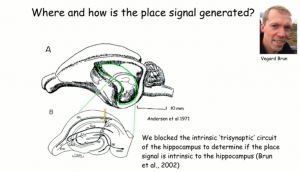
After that, in 2004, May-Britt Moser ve Edvard Moser directed their attention to a nearby area, the entorhinal cortex, because they found out when they block the specific area in the hippocampus, they still have place cells, so the area they were looking for was somewhere else.
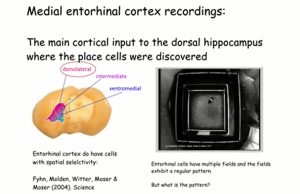
When they lead discovered cells, they called them grid cells, fired each time the rat is in specific locations in the room. From these locations, a distinct pattern appeared, an almost perfect hexagonal great pattern recovered the entire room just like the holes of the beehive.
This system allows the grid cells to define distances and directions, creating an inner coordinate system in the brain which is necessary for navigating through an environment. So it is probable that the grid system is responsible for providing the place cells that standard of measurement required when special maps are created in the hippocampus. Together with other brain cells with similar functions, they form a complex circuitry comprising a sort of inner GPS in the brain.

The research done by O’keef and Moses has all been on mice and rats. So the next question that comes to mind was if this experiment allows us to draw the same conclusions for humans or not. It is founded that the comparison of the brains of humans and rats and the chemical signals, electrical impulses, and circuitries shows that they are astonishingly similar.
Can it be new for Alzheimer’s Disease?
As it happens, the area containing grid cells is the same area in humans that is 1st damaged in many patients suffering from Alzheimer’s disease. In fact, one of the 1st symptoms of Alzheimer’s disease and dementia is the patients become disoriented and have trouble finding their way. So being able to understand the mechanisms underlying special cognitive functions is a major leap forward when trying to treat different neurological and psychiatric diseases. By these collective discoveries by John O’Keefe, Brett Moser, and Edvard Moser, future researches have brightened understanding other cognitive processes such as memory, thinking, and planning.

References: