
33,000 years ago, a person died in a cave in what is now Romania. In 1941, phosphate miners discovered the fractured skull. And that was the full extent of knowledge about the find, before a scientist at the University of Crete applied a modern forensic analysis to the skull and labeled it Murder! (Scully, 2019). The application of modern forensic science to ancient crimes is termed Forensic Archaeology.
What is Forensic Archaeology?
Let’s start with a definition.

Applying the techniques of archaeology to forensics, allows a specialist to link human remains and objects surrounding them, in a way that might not be obvious to an ordinary Crime Scene Investigator. The proximity of finds to each other tells the specialist information about their function. Archaeology is very similar to the regular crime scene process, (described in detail here. https://mozartcultures.com/en/working-the-crime-scene-control-preserve-record-recover/ ) in that access must be restricted to people who understand the process, and every find must be recorded before recovery. An excavation has the potential to damage recovered items, therefore every care must be taken to minimise possible harm.
According to Madelaine Stephens of Alecto Forensics, forensic archaeology can be defined as using methods traditionally associated with Archaeology to search for, locate, dig for, and recover evidence and human remains (Alecto Forensics, 2024). As with regular archaeology, the forensic version requires the specialist to put together all the information provided in the search, and provide an interpretation.
How does the forensic Archaeology work?
While studying forensic archaeology, you are learning such things as gravesite identification, layer stratigraphy for dating finds, and how to link finds in context.
Grave Site Identification
By studying the landscape, particularly vegetation, it is possible to locate potential grave sites. Crop marks are a case in point. Take a hole in the ground. If it is filled in with soil, then crops are likely to grow better than the surrounding plants, making a spot of larger, greener plants, as seen in image 2.

https://commons.wikimedia.org/wiki/File:Crop_Marks_-_geograph.org.uk_-_2418848.jpg
However, if the hole is filled with rubble, then the plants above the hole are likely to have stunted growth, as shown in image 3 (Future Learn).
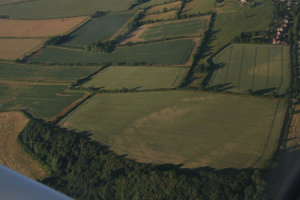
https://commons.wikimedia.org/wiki/File:Crop_marks_in_a_field_in_Casthorpe_Hills_-_geograph.org.uk_-_5846328.jpg
Dating evidence by Stratigraphy
Often it’s necessary to know the date of a piece of evidence. In forensic archaeology, this can be approximated by Stratigraphy. The principle behind stratigraphy is that deposits are laid down in layers. Newer deposits lay over the top of materials, such that the deeper the hole is dug the older any finds are likely to be. This is the case in rural environments, but in the case of urban conditions, where the layers have been disturbed for building, it is not always so clear-cut. Each deposition layer is carefully recorded and removed before digging any deeper (Future Learn).
Determination of context
Evidence is useless unless it comes with some context. Take fingerprints. If you find a fingermark on a window, it could have been made by a window cleaner, but if it’s on the murder weapon the mark is linked to a crime. So it is with context in forensic archaeology. Say, human remains have been discovered. The forensic archaeologist inspects the ground to determine if the body was buried, suggesting human action, or just lying in the open ground, suggesting death by elements. Context is everything when it comes to deciding whether or not a crime might have taken place (Future Learn).
So how does this relate to Forensic Investigation of Ancient Crime?
The easiest way to explain how to apply forensic archaeology to ancient crimes is via case studies.
Case Study 1: Romanian Stone Age Skull
As mentioned in the introduction, phosphate miners in Romania unearthed a fractured skull. No more context than this was provided. More recently, a group of scientists decided to apply modern forensic techniques to the skull. First of all the scientists had to decide if the injury was pre-, peri-, or post-mortem—that is, did the injury happen before death, was it the cause of death, or did the breakage happen after the person was dead?
A bit of science
A pre-mortem injury would have shown some healing. According to studies on injured people from the American Civil War, bone damage shows signs of healing after 5 to 7 days. Examining the skull found no indication of repair. Damage to the skull after death would give very characteristic square fractures. Taking a closer look, the bone had a rounded break. From this information, the group concluded that the injury was the cause of death.
To work out the type of weapon used, the researchers created bone-like balls with a gelatine interior and hit them with a rock, a 10-meter fall, and a baseball bat. On examining the skull substitutes, the team discovered that a rock created a small puncture wound, the fall shattered a larger portion of the skull-substitute, but the rounded baseball bat created the exact wound found on the Romanian skull. From this evidence, the scientists agreed that the victim had been hit by another person with a rounded, club-like weapon (Kranioti, 2019). The victim had been murdered, 33,000 years ago.
Case Study 2: Bog Bodies
Sometimes human remains are uncovered and the police are called, because the state of preservation is such that everyone believes the human remains are recent. On 25 January 2024, police in Northern Ireland were called out for the discovery of human remains. The chief investigator, Detective Inspector Nikki Deehan told reporters that the remains were so well preserved in the peaty soil that no one realized it was not a recent death. It has been suggested that the Irish Republican Army (IRA) used The Black Bog in Northern Ireland, during The Troubles, to hide their victims. Therefore, because of the state of preservation of this body, the exhumation received full forensic attention to prevent any cross-contamination (Media, 2024).
When unearthed, even the soft tissues had been mummified. This level of preservation is unusual in prehistoric bodies. It only happens in these cases because of the anaerobic conditions of a peat bog. The lack of oxygen prevents the usual decomposition, and natural tannins mean that even the contents of the stomach are retained for modern study (The Editors, 2024). Only when the body was radiocarbon dated, did the investigators realize that the young man had lived in the Iron Age (Media, 2024).
A bit of science
The atom, Carbon, has several forms or isotopes, which decay (change into other substances) over set periods of time. The theory goes that living things, both plant and animal, absorb the isotope Carbon-14 (C-14). When they die, C-14 gradually decays into Nitrogen-14. By counting the amount of C-14 left in the organic matter, researchers can tell roughly when the living creature or plant died. The method of using these changes was developed by Willard Libby of the University of Chicago in the 1940s (Koppes).
When examined, the found that many of the bodies found preserved in bogs and peat died by violence. Researchers have suggested that these people were human sacrifices rather than plain murder because of the apparently ritualistic method of their deaths. One man had marks on his head from a blow and appeared to have been strangled before having his throat cut.
Remember, I mentioned the preservation of stomach contents? Some of these victims appear to have eaten ritualistic last meals containing plants that may have caused hallucinations. However, these people died so far in the past that we cannot be certain as to motivations or consequences. After all, a man suffering from hallucinations, might just wander accidentally into a bog and drown (Sky History, 2024).
Conclusion
Forensic Archaeology is a fascinating subject to study. The attempts to understand these apparently violent deaths from centuries ago have led researchers to adopt the methods of forensic science. While we cannot solve Ancient Crime, the application of modern forensic science can teach us a little more about how our ancestors lived.
References
Alecto Forensics (2024). The Uses and Application of Archaeology in Forensic Investigations. Alectoorensics.com. https://www.alectoforensics.com/the-uses-and-applications-of-archaeology-in-forensic-investigations/
Future Learn. What Does a Forensic Archaeologist do? Durham University. https://www.futurelearn.com/info/courses/forensic-archaeology-and-anthropology/0/steps/67860
Koppes, S. & Lerner, L. Carbon-14 Dating Explained. UChicago News, University of Chicago Office of Communications. https://news.uchicago.edu/explainer/what-is-carbon-14-dating#what
Kranioti, E. F., Grigorescu, D., & Harvati, K. (2019). State of the art forensic techniques reveal evidence of interpersonal violence ca. 30,000 years ago. PloS one, 14(7), e0216718. https://doi.org/10.1371/journal.pone.0216718
Media Relations Team. (2024) The Bog is Where Forensics and Archaeology Meet to Solve Cold Cases. Cranfield University. 27 Feb. https://www.cranfield.ac.uk/press/news-2024/the-bog-is-where-forensics-and-archaeology-meet-to-solve-cold-cases
Scully, R.P. (2019). Modern Forensics Solves Stone Age Murder Mystery after 33,000 Years. New Scientist. 3 July. https://www.newscientist.com/article/2208455-modern-forensics-solves-stone-age-murder-mystery-after-33000-years/
Sky History. (2024) Who are the Bog People? Accidental Mummies from Northern Europe. A+E Networks. https://www.history.co.uk/articles/the-bog-people-accidental-mummies-from-northern-europe
The Editors. (2024). Bog Body. Encyclopædia Britannica. 6 June. https://www.britannica.com/science/bog-body


