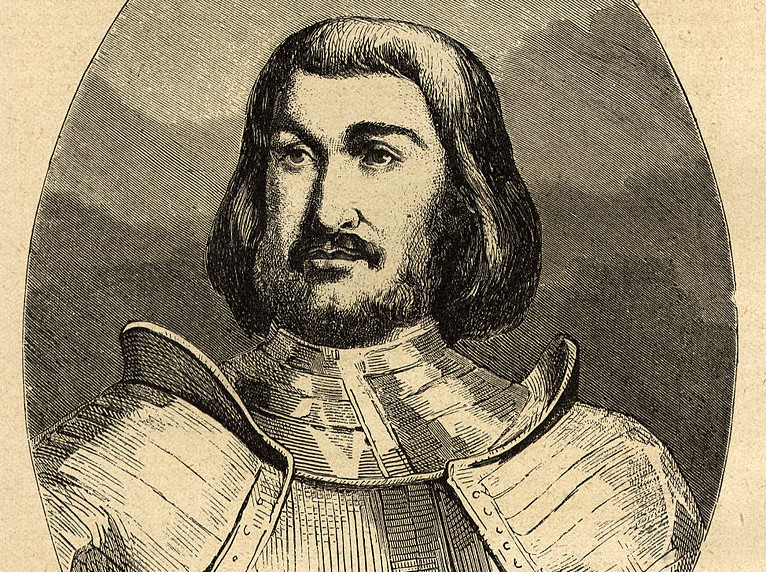
Many of you may have heard about the story of Bluebeard, a french rich man who murdered his wives one after another and kept them in a secret room at his castle. But what many of you may not know is there was a real story, a real man, who inspired this tale.

His name was Gilles de Rais, a nobleman who lived through the first half of the XV century in France. He inherited the title of baron of Retz as well as an important number of fields and castles. But thanks to his military services, he got the title of Field Marshal and increased his already sumptuous fortune. Some even say he was richer than the king of France and this made the king jealous, but during his last days, he sold almost every possession he had acquired trying to keep his “extravagant” lifestyle.
One of the most important facts of his biography is his military career. Gilles de Rais was a skilled soldier who served as a commander in the Royal Army against the English troops. He fought alongside Joan of Arc, whom he was obsessed with, and defended her as a God emissary even when the king wouldn’t. His victories and bravery on the battlefield got him the just mentioned title of Field Marshal of France, as well as the honor to add the royal arms (fleur-de-lys) to his own coat of arms. During this time, Gilles de Rais was an admired, loved, and honored war hero, but that good fame didn’t last forever.
In fact, from the very beginning, Gilles de Rais showed a dark personality. He was raised by a very strict grandfather who didn’t show him much love, but I don’t think that explains the fact Gilles already enjoyed violence when he was just a teen. He liked to make the animals he hunted go through severe suffering before killing them, and some authors also think during his adolescence he had already started to torture the servants. But what we know for sure is his taste for violence escalated fast.

Gilles de Rais had many castles through the french territory, and he and his friends would go from castle to castle throwing wild parties and, according to some authors, also doing satanic rites. They avoided staying for much time in just one place thinking that way they wouldn’t be linked to the “disappearance” of the kids they kidnapped, tortured, and murdered in every village. But that strategy didn’t work out and a large number of disappearances got the attention of the Inquisition.
The total amount of victims has never been assured, and the numbers the historians talk about going from 100 to 600 children. The kids they abducted were tortured in the worst ways imaginable for the enjoyment of the baron and his sadic crew. I don’t want to get into the bloody details, but in his own confession he testified:
“ […] when the said children were dead, I kissed them and those who had the most handsome limbs and heads I held up to admire them, and had their bodies cruelly cut open and took delight at the sight of their inner organs; and very often when the children were dying I sat on their stomachs and took pleasure in seeing them die and laughed”
Benedetti, Jean (1971), Gilles de Rais, New York: Stein and Day. P. 115.
Gilles de Rais and his followers were sentenced to death, and he was executed, hanged and burned, on October 25th of 1440.
Lately, a lot of historians think he was a victim of a plot orchestrated by king Charles VII and the church and they are re-writing the history of this controversial Marshal of France.
Sources:
- CEBRÁN, J. A. (2005). “El mariscal de las tiniebas: La verdadera hsitoria de Barba Azul”. Ed. Temas de Hoy, Barcelona.
- https://commons.wikimedia.org/wiki/File:Féron_-_Gilles_de_Rais_(1405-1440)_-_MV_962.jpg
- https://es.m.wikipedia.org/wiki/Archivo:Blason_Gilles_de_Rais.svg
- https://historia-biografia.com/gilles-de-rais/