Little Girl Sadako’s Hiroshima
Destroying a City and Lives
Little Girl Sadako’s Hiroshima was destroyed by a nuclear bomb named “Little Boy” in 1945 when she was just 2 years old. She got stuck in the middle of a deadly war that lost more than 220,000 people. This radiation bomb, which brought the end of the war, caused a brutal trauma for Sadako and many of her people. In this little girl Sadako’s Hiroshima, while many people died or were injured within seconds after the attack, some suffered from radiation-induced illnesses or died months or years later. Sadako was one in who the impact of the bomb appeared years later. Ten years after the bomb went off, she developed Leukaemia and was hospitalized for treatment.

The Legend of One Thousand Cranes
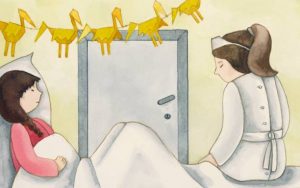
Despite all the traumas she had experienced, she never lost the hope of getting better. One day, while Sadako was being treated at the hospital, someone reminded her of a legend. The legend was this: If a person folds 1,000 cranes out of paper, his or her wishes will come true. When Sadako heard this, she was thrilled. A little more was added to her inner hope, and excitedly began to fold the cranes.
Sadako’s Goodbye
Unfortunately, Sadako succumbed to Leukaemia on her 644th crane and died on October 25, 1955. However, her friends completed the cranes to 1,000 and subsequently fulfilled Sadako’s wish. After her death, she became an important symbol of peace all over the world, leading to her own hope to flourish in other people’s gardens. This was a miracle that not everyone was lucky enough to accomplish.

“Little Girl”
After Sadako’s tragic death, the famous Turkish poet Nazım Hikmet wrote a poem called “Little Girl” referring to the “Little Boy” bomb dropped on Hiroshima. The little ghost girl in this poem was actually Sadako; in fact, it was all the children who died because of the war. This touching poem reveals how children, the most important creators of the future, were ignored and left to death during the war. (The Turkish version of the poem and its English translated version by Hulusi Çınar are below (https://hulusicinar.wordpress.com/2014/01/30/pete-seeger-nazim-hikmet-ve-kiz-cocugu-siiri/))
 Turkish Poet Nazım Hikmet
KIZ ÇOCUĞU
Kapıları çalan benim
kapıları birer birer.
Gözünüze görünemem
göze görünmez ölüler.
Hiroşima’da öleli
oluyor bir on yıl kadar.
Yedi yaşında bir kızım,
büyümez ölü çocuklar.
Saçlarım tutuştu önce,
gözlerim yandı kavruldu.
Bir avuç kül oluverdim,
külüm havaya savruldu.
Benim sizden kendim için
hiçbir şey istediğim yok.
Şeker bile yiyemez ki
kâat gibi yanan çocuk.
Çalıyorum kapınızı,
teyze, amca, bir imza ver.
Çocuklar öldürülmesin
şeker de yiyebilsinler.
GIRL
On the doors one by one
knocks the girl that I am.
I cannot appear to your eyes
the dead cannot be seen by ’em.
I died in Hiroshima
almost a decade ago.
I stay a seven year old girl
’cause dead kids will not grow.
My hair was aflame at first,
my eyes seared and burned.
Suddenly I turned to ashes
my ashes tossed and hurled.
I do not want anything
for my little self from you.
How a kid eats a candy
if only she boils like a glue.
I knock on your doors,
mister, missus, sign my plea.
That kids shall not be killed
and candy should be free.
Fazıl Say’s Oratorio
This dolorous poem by Nazım Hikmet was brought into many other art forms. Its oratorio was displayed on the stages and its songs was sang to the masses. A Turkish pianist Fazıl Say’s oratorio which is dedicated to Nazım Hikmet also includes this poem, sung by a little girl. Listening to it, it truly is a storm breaking within our hearts.
https://www.youtube.com/watch?v=BcFDLR-AOWQ
 Turkish Pianist Fazıl Say
“I Come and Stand By”
In addition to all this, American Folk singer Pete Seeger composed a song for “Little Girl” in the title of “I come and stand by”. This version of the poem is actually a free-style translation by Jeanette. Although it is not an exact translation, it’s meant to evoke the emotions of the original one. One of the best singers that brings life to the song is the band ‘This Mortal Coil’. Here below is the link to it.
https://www.youtube.com/watch?v=6vZ0KgLifjI&t=236s

“A War Against Children”
These pieces, written and composed for Sadako and children like her, survive until today and keep them alive in a certain sense. At the same time, because of their anti-war qualities, these pieces teach the future generations not to make the same mistakes of the past generations. The war is painful for everyone, but when it comes to children– the most vulnerable beings, it is truly agonizing. For whatever the reason might be to go to war, the children are the ones who suffer the most. As Howard Zinn once said: “We need to decide that we will not go to war, whatever reason is conjured up by the politicians or the media, because war in our time is always indiscriminate, a war against innocents, a war against children.” And that’s what Sadako wished in her fleeting life.

References
https://www.nationalww2museum.org/war/articles/atomic-bomb-hiroshima.
https://en.wikipedia.org/wiki/Sadako_and_the_Thousand_Paper_Cranes.
https://en.wikipedia.org/wiki/Sadako_Sasaki.