A promissory note guarantees payment of a certain amount of money from one party, from the lender (often a bank or institution) to the other party, the borrower (the payee, the person who will pay back the loan or debt).
See also: A Big Shock For The Capitalism: Occupy Wall Street
The note is a legal instrument, or more accurately a debt instrument, meant to establish when the debt will be paid, either on-demand or on a specified future date.
In the United States, a promissory note is considered a negotiable instrument when it meets certain conditions and is unconditional and sealable. Meaning, that a promissory note is a document contemplated by or consisting of a contract.
This document, once signed, promises the payment of the money without condition on-demand or at a set time. The payer is usually named in the document. If a promissory note meets certain conditions it is a negotiable instrument as regulated by article 3 of the Uniform Commercial Code (UCC).
The UCC, established in 1952, is one of the Uniform Acts that have been established as law with the goal of creating a harmony between sales law and commercial sales across all 50 US states, the District of Columbia, and all United States territories.
What is and isn’t considered a promissory note is detailed in section 3-104(d) of the UCC.
When created in the United States, promissory notes are generally issued to investors and corporate clients. However, they are used more and more for selling homes, mortgages, and signing for small loans.
There are three forms of a promissory note: secured, unsecured, or Master Promissory Note (MPN). A promissory note is secure if the borrower places a safeguard on the loan in the form of collateral (such as a property or car) so as to ensure that the debt is paid.
A promissory note that is unsecured does not have the same requirements as a secure promissory note, however, the debt still needs to be paid. In the case of a Master Promissory Note (MPN) the borrower and the lenders can use an MPN promissory note across multiple loans.
When deciding how to compose a promissory note, there are many key components to outline the terms of the agreement. First, you must include the borrower’s name and contact information in addition to the lender’s details and contact information.
In the document, it must state the principal loan amount, the interest rate, and how the rate has been calculated. Next, is the date that the first payment is required and the loan maturity date. Depending on the nature of the promissory note, there will also be a description of the frequency with which payments will be made and how much will be paid at each payment. If it is going to be a secured promissory note, any collateral that will be put up should also be written in the promissory note. It is also obligatory to include the date and place that the promissory note was issued, any fees and charges associated with the note, and the repayment terms and options. Finally, the loan conditions must be stated in full followed by the borrower’s and the lender’s dated signature. These signatures make the document a contract and a legally binding document.
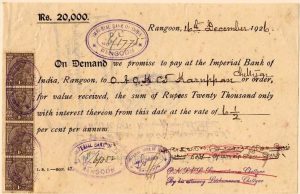
All of these components are relevant information to the promissory note and make it a negotiable instrument. Once signed, the promissory note holds a legal obligation for the borrower to pay back the lender at a fixed or determinable future date.