Magnetic Field Flip of the Sun: Solar Cycle

Solar cycle
The suns magnetic field changes polarity in about 11 years. In other words, South becomes North and North becomes South. In December 2019, a new Solar Cycle has begun which is called Solar Cycle 25 and expected to continue until 2030.
To understand the solar cycle and process clearly, let’s find out what sunspots are;
Sunspots
Sunspots occur in regions where the magnetic field is much stronger than other fields on the Sun. Strong magnetic field of the area, decreases atmospheric pressure in the surrounding area and blocks the flow of hot gas from inside the Sun to the surface. Thus, a colder areas, compared to its surroundings, form. These relatively cold areas appear as dark spots and are called as sunspot.

Yet, don’t be fooled by the words cold and dark, because the sunspot is about 3,800 degrees K. (The photosphere, where sunspots form, has a temperature of 5,800 degrees K.), and if we separate an average-sized sunspot from the sun, it can emit as much light as a bright full moon.
The sunspots we mentioned above start from zero (solar minimum), reach their peak (solar maximum), and fall back to zero with each new solar cycle. However, it would not be correct to explain these cycles only in terms of the number of sunspots.

Location of the Sunspots
Another thing that is important to observe the tracking of the cycle is where the sunspots are. In solar minimum, the first phase of each solar cycle, the sun can pass its days without any sunspots. Later, sunspots begin to form in latitudes of 30° to 45° North and South of the Sun’s equator. In the transition to the Solar Maximum, sunspots progress up to the latitude of 15°. Towards to the end of the cycle sunspots form quite close to the solar equator, around 7° North and South latitude.
The sun is very active in periods when the number of sunspots is high. Sunspots are an explicit indication of imbalances in the sun’s magnetic field, and this magnetic field can also cause solar flares and coronal mass ejections. Finally, this occurrence affects the space weather, and our planet.
İmpacts of Solar Cycle
Solar Maximum
- During the solar maximum, a lot of fake news is spreading that we are going to have extremely hot days. İndeed, yes, the temperature in the upper atmosphere of our planet increases with the radiation of the sun. However, the lower atmosphere insulates this and protects our planet from this temperature increase. Moreover, measurements indicates that the lower atmosphere is hotter than the upper atmosphere. This result clearly shows us that the main concern is not the solar maximum. As the cause of this warming is related to global warming rather than solar maximum.
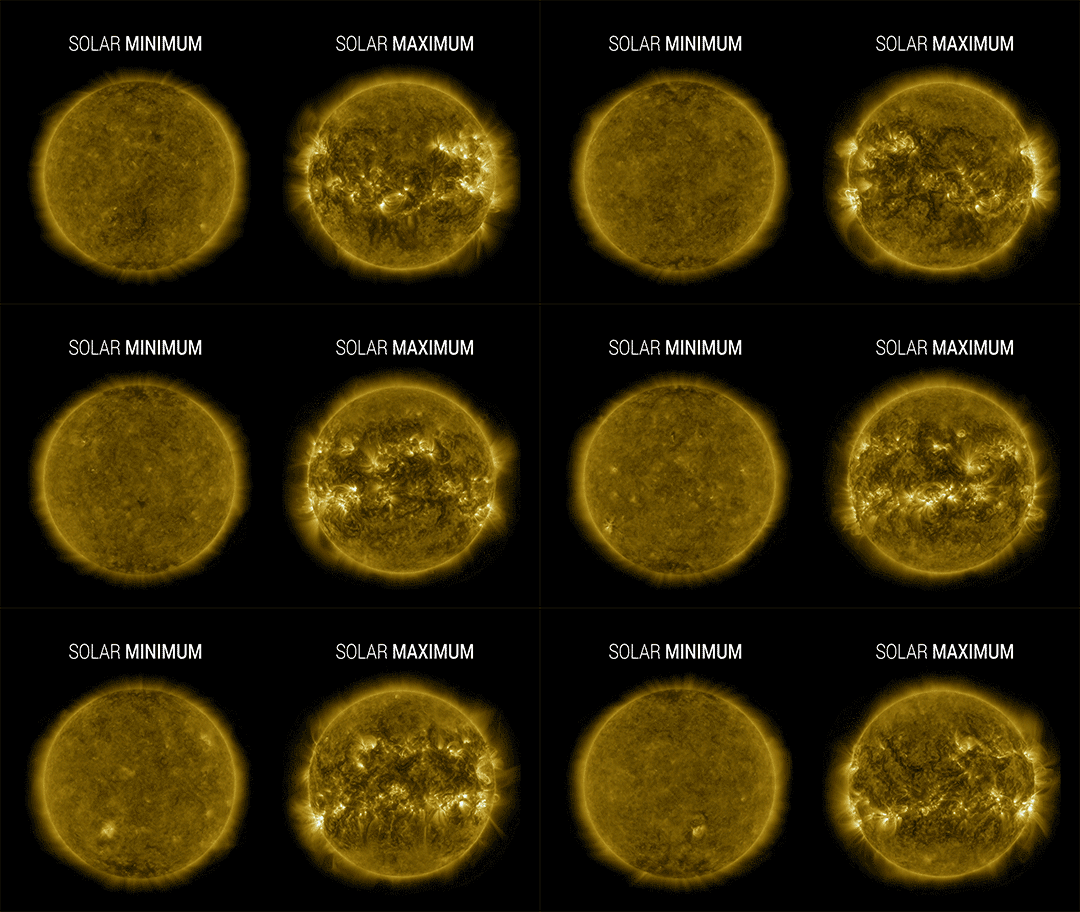
Solar Minimum
- Another argument about the solar cycle is that during solar minimum we will experience very cold days, or even be in danger of an ice age. On the contrary, NASA says that there is a little evidence that the solar minimum could cause a climatic cold. The prevalence of this belief is often due to the period known as the Little Ice Age (1303-1860). It is generally thought to be caused by the Maunder Minimum. It is the period between 1645 and 1715 when sunspots became extremely rare. However, the Little Ice Age began long before the Maunder Minimum period. While scientists cannot find a precise reason, there are theories that the increased volcanic activity and changes in ocean currents during the period also contributed to the Little Ice Age.
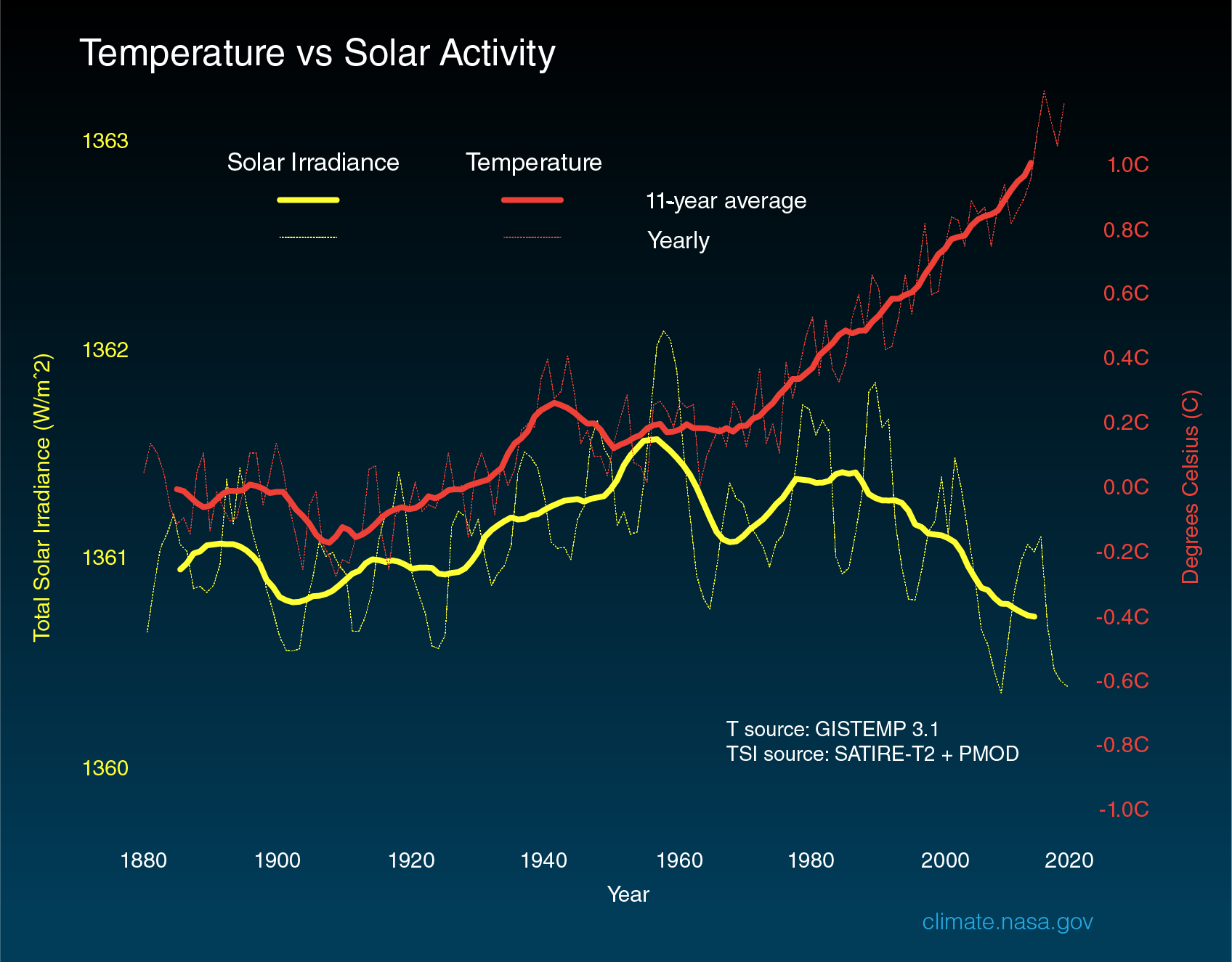
Furthermore, in the graph shared by NASA, it is seen that even a possible climatic cooling caused by the solar minimum cannot compensate human-induced warming. Considering that global warming is getting worse day by day, it is unlikely that we will experience a climatic cooling only due to solar minimum.
- Changes in solar activity affects astronauts, electric power systems (March 1989 geomagnetic storm), create disruptions in communication systems and may shorten the life of satellites. So, it is very crucial to observe possible activities in the solar cycle that will affect us.