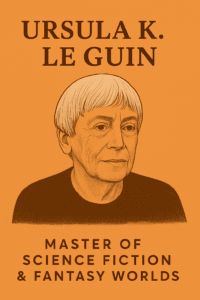
Ursula K. Le Guin (1929–2018) was an American author whose groundbreaking work reshaped modern science fiction and fantasy. Her stories, deeply human yet brilliantly imaginative, bridge anthropology, philosophy, psychology, and myth. She didn’t just create worlds she built thoughtful universes that explore culture, gender, balance, and power.
Early Life and Intellectual Roots
Born in Berkeley, California, Le Guin was surrounded by an academic and creative environment. Her father, Alfred L. Kroeber, was a pioneering anthropologist, and her mother, Theodora Kroeber, was a writer. This background fostered an early fascination with culture, human behavior, and storytelling.
After studying French and Italian literature at Radcliffe College and Columbia University, Le Guin turned to science fiction and fantasy genres often overlooked by the literary mainstream. She once said:
“Science fiction was excluded from critical, academic, canonical supervision, leaving the artist free.”
This freedom allowed her to push boundaries and explore profound philosophical questions in accessible, imaginative ways.
Landmark Works
The Earthsea Cycle Magic and Balance
Le Guin’s first major breakthrough came with “A Wizard of Earthsea” (1968), the opening novel of her beloved Earthsea Cycle. Initially marketed as a young adult fantasy, it captivated readers of all ages with its psychological depth and Taoist themes. The protagonist, Ged, embarks on a journey to face his inner shadow — a clear reflection of Carl Jung’s “Shadow Archetype.”
The series (The Tombs of Atuan, The Farthest Shore, Tehanu) expanded to tackle identity, power, and gender, establishing Earthsea as one of the most sophisticated fantasy universes ever created.
The Left Hand of Darkness Gender and Society
Published in 1969, “The Left Hand of Darkness” revolutionized science fiction. Set on the icy planet of Gethen, its inhabitants are ambisexual, shifting between male and female phases. This unique concept explores how gender shapes society, politics, and relationships and imagines a world without rigid gender roles or war.
The book earned Le Guin both the Hugo and Nebula Awards, making her the first woman to win both for a single novel.
Essays, Children’s Books, and More
Le Guin’s creativity spanned beyond novels:
-
Catwings series whimsical stories about winged cats, delighting young readers.
-
The Language of the Night essays on fantasy writing and creativity.
-
Words Are My Matter and No Time to Spare sharp reflections on life, literature, and society.
Philosophical and Cultural Influences
-
Anthropology: Her father’s influence is clear in works that examine culture clash and coexistence. Her early Hainish novels (Rocannon’s World, Planet of Exile, City of Illusions) portray humans interacting with alien civilizations, mirroring anthropological fieldwork.
-
Taoism: Central to her work, Taoist thought shapes Earthsea’s concept of balance and the interplay of opposites land/sea, light/dark, life/death.
-
Jungian Psychology: Archetypes and the unconscious play crucial roles, especially in characters confronting their hidden selves.
Feminist Science Fiction Pioneer
Le Guin broke new ground by integrating feminist ideas into speculative fiction. Her early work questioned gender assumptions, but The Left Hand of Darkness and later Earthsea books directly challenged patriarchal norms. She gave voice to female characters with complexity, agency, and quiet power inspiring generations of writers and readers.
Legacy and Impact
Le Guin’s influence extends beyond literature:
-
She legitimized fantasy and science fiction as art forms capable of exploring deep philosophical and cultural issues.
-
She inspired countless authors from Neil Gaiman to N.K. Jemisin who credit her with expanding the genre’s emotional and intellectual horizons.
-
Her works continue to spark adaptation and scholarly study, including the acclaimed documentary “The Worlds of Ursula K. Le Guin.”
Suggested Entry Points
If you’re new to Le Guin’s writing:
-
Fantasy lovers: Start with A Wizard of Earthsea.
-
Social commentary seekers: Read The Left Hand of Darkness.
-
Personal reflections & essays: Try No Time to Spare or Words Are My Matter.
Frequently Asked Questions (FAQ)
Who was Ursula K. Le Guin?
Ursula K. Le Guin was an American writer known for reshaping science fiction and fantasy with deep philosophical, anthropological, and feminist themes.
What are her most famous books?
Her most iconic works include the Earthsea series and The Left Hand of Darkness. Other notable titles are The Dispossessed, City of Illusions, and No Time to Spare.
Why is “The Left Hand of Darkness” important?
It revolutionized science fiction by exploring gender fluidity and imagining a peaceful, non-patriarchal society groundbreaking for its time.
What philosophical ideas influenced her?
Le Guin drew from Taoism (balance, harmony), Jungian psychology (shadow archetype, self-discovery), and cultural anthropology.
Are Ursula K. Le Guin’s books suitable for children?
Some are like the Catwings series. But works such as Earthsea and The Left Hand of Darkness are best appreciated by teens and adults due to their complexity.
Where should I start reading Ursula K. Le Guin?
Fantasy readers should begin with A Wizard of Earthsea; those interested in gender and society can start with The Left Hand of Darkness.