Who is Rembrandt?
Rembrandt Harmenszoon Van Rjin was born in the Netherlands in 1605.
The Netherlands lived in the Golden Age. The reason why this name was given to the period is because of the culmination of culture, science, trade and politics in the Netherlands.
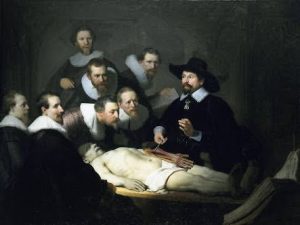
Life of Rembrandt
Rembrandt was frequently punished for painting portraits of his teachers and classmates throughout his education life. When he was 14, he was taken from school and given to the studio of the painter Jacob Isaaksz van Swanenburch.
He learned the art and perspective of color mixing here, imitated Swanenburch and tried to improve his technique. Later he went to Amsterdam and started to work with the painter Pieter Lastmann, where he learned the art of using light, shadow and color.
He made his experiments of light and shadow for the first time by pressing the compositions he received from the Bible on engravings. It specializes in the art of engraving.

The influence of Lastmann can be seen in early paintings such as “The Martyrdom of St. Stephen (1625)” and “The Baptism of Eunuch (1626)”. At the same time, the influences of Caravaggio can be seen in the works of Rembrandt van Rjin, as the two painters he studied were also fascinated by Italian painting.
He returned to his hometown Leyda in 1625 and returned to Amsterdam with the death of his father.
He married Saskia van Uylenburgh in 1634. In his paintings “The Blinding of Samson” and “Susanna in the Bath”, he used his wife Saskia as a model.
Thus, he became the most successful portrait painter in Amsterdam. Because he attached importance to the changes of the human soul and inner expression and reflected it on his works.
Art of Rembrandt
He showed himself with the light and shadow techniques he used and made red find its true value on the basis of art history. He became the most realistic painter of his time because he gave life to mythological heroes by using the people living around him.
He made a painting called “Night Patrol” upon the order of the Amsterdam Snipers Guild. Not conforming to old tradition; The 365 x 438 cm painting is actually Rembrandt’s masterpiece, at the same time the most valuable work of Dutch painting, but it was not appreciated enough.
In 1662, the members of the Amsterdam Manifaturators’ Union Board of Directors were asked to paint collectively, so he painted the group portrait called Union Members
Rembrandt van Rjin, who witnessed the deaths of his relatives in his life, lost first his mother and then his wife.
Rembrandt, who stayed with his son Titus, therefore took a widowed caretaker with him. He hired a 25-year-old servant girl named Hendrickje Stoffels in 1645, after he survived a hysterical caretaker who took care of both his son and Rembrandt too much.
He fell in love with Hendrickje, but his deceased wife, Saskia, did not marry Hendrickje because in his will he left Rembrandt in his will stating that he could not benefit from the wealth he left if he married. Later, in 1654, a daughter named Comelia was born from Hendrickje.

Meanwhile, the painter’s customers started to decrease. Because Rembrandt, who was also outspoken, found class differences meaningless and showed this idea with his paintings. Later, he broke up with the aristocratic segment and said that his art was out of fashion. That’s why they stopped ordering Rembrandt.
Hendrickje, with whom he lived in these periods, became the model of his paintings named “David’s Wife Batşaba” and “Woman Washing”. At the same time, he made the painting “Hendrickje Stoffels Dressed as Flore” for Hendrickje.
An inexhaustible dark period began for Rembrandt, who lost Hendrickje a few years later and his son Titus in 1662. He fell into his last and eternal sleep on October 4, 1669, after watching his last painting, the self-portrait: “Portrait of Old Age”.
He was buried in an unknown grave in Westerkerk on October 8, 1669. Today, the house, which was converted into a museum in Amsterdam, has been opened to visitors.
ART101: 4 20-th Century Art Movement You SHOULD Know