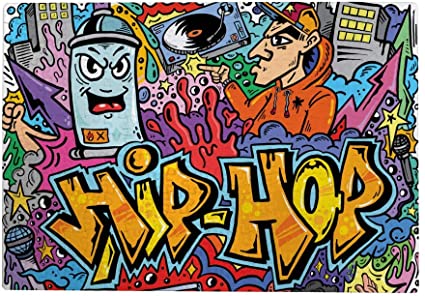
Decades ago (and yet to some it may seem like yesterday), we had disco, some great movies, an era of economic struggle, cultural change and technological innovation. A pretty interesting era. The 1970’s were something special to all who went through them, but I’d bet every generation could say that for their era. But one very special thing that the 70’s brought us, is a culture and a genre that was invented for the pure fun, joy and reconciliation. We won’t talk about how it became a money making machine, at least not in this article.
Born on August 11th, 1973, thanks to DJ Kool Herc and the first MC ever Coke La Rock, Hip-Hop is a culture that can now be said to connect the whole world. You can hear the impact of it in almost every single musical genre, but the actual beauty is that it transcends music. It is a subculture and an art movement that was developed by African Americans and Puerto Ricans during the 1970s. He performed the ground breaking art form of the Merry-Go-Round, playing the same two records, isolating the funkiest percussion sections, extending those five second break beats into five minutes of dance fury. Coke La Rock, Kool Here’s friend, hyped up the crowd with a microphone. And from then on, Hip-Hop was born. From then on, DJ Kool Herc is known as the founding father of Hip-Hop and eventually DJ Kool Herc had to move the party outside from 1520 Sedgwick Ave. to Cedar Park. That August 11th is was the first night all the elements of hip-hop came together to become Hip-Hop: There were DJing, MCing (to the breaks), breakdancing (to the breaks), and graffiting.
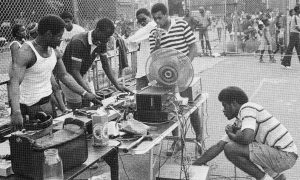
DJ KOOL HERC INVENTS HIP-HOP AT 1520 SEDGWICK AVENUE. (2020, June 20). [Photograph]. BACKYARD OPERA. https://www.backyardopera.com/music-17/2020/6/10/history-dj-kool-herc-invents-hip-hop-at-1520-sedgwick-avenue-nc2x8
During the whole 20th century, African-American people struggled with racism to its fullest. Even though, slavery was made illegal a century before, that did not stop some people from looking down on somebody with a different skin colour. And even though it was always officially scolded upon, racism was still pretty active. To this day, even though it has significantly dropped, we are still witnesses to racial intolerance, so the author would like to use this opportunity to remind everyone, that we are all human beings made from flesh and blood. No one is better or worse than others, just because our skin tones do not match, live on different continents, or the financial status is not on an “adequate” level to someones’ terms. We are all human, so please treat each other with respect and spread the love as much as you can, for you never now where it might be needed.
Witnessing and experiencing the impact of the parties on themselves and the people around them, many young black and latino men and women wished to be a part of the new trend, and started experiencing Hip-Hop on their own, with their own contribution to the trend itself. One such young man was Lance Taylor. When Lance won an essay contest that earned him a trip to Africa, his worldview shifted. He had seen the movie Zulu and was impressed with the solidarity exhibited by the Zulu in that film. During his trip to Africa, the communities he visited inspired him to create one in his own neighbourhood. He changed his name to “Afrika Bambaataa Aasim”, adopting the name of the Zulu chief Bhambatha, who led an armed rebellion against unfair economic practices in early 20th century South Africa. He told people that his name was Zulu for “affectionate leader”, a.k.a. Afrika Bambaataa. He returned with a vision to transmute gang violence into cultural battles based in music, dance, and the arts. He founded the Zulu Nation as a new kind of consciousness-raising gang. An influential DJ in New York City’s club scene, “Bam” crafted a global electrobeat with the Soul Sonic Force. He mixed disco and funk with the rhythms of DJ Kool Herc (Jamaica), Kraftwerk (Germany), and the Yellow Magic Orchestra (Japan). An intimidating figure with a tight scowl who often wears a floor-length leather coat, Bambaataa still gives this simple advice to DJs and rappers: “You must seek knowledge.” His club hit “Looking for the Perfect Beat” distilled into five words the elusive musical quest of the African diaspora in its American form.

[Lance Taylor a.k.a. Afrika Bambaataa on the turntables]. (n.d.). Pinterest. https://www.pinterest.com/pin/543106036288862586/
Afrika Bambaataa was the first to articulate an ideology for the emerging youth culture, using the music to illustrate hip-hop’s expansive potential as a global movement. As a DJ and recording artist, Bambaataa embraced every musical genre to establish hip-hop as an aesthetic form based on juxtaposition and appropriation. As a leading spokesman for the hip-hop generation, Bambaataa delineated the four elements of hip-hop as rapping, DJing, breakdancing and graffiti-writing, giving the manifold trends of late seventies minority youth in New York City a definitive coherence.
Resources:
Goldman, H. (2021, May 19). Afrika Bambaataa (1957- ) •. Black Past. https://www.blackpast.org/african-american-history/bambaataa-afrika-1957/#:%7E:text=As%20a%20leading%20spokesman%20for,York%20City%20a%20definitive%20coherence.
D. (2020, November 16). The OG 4 Elements of Hip-Hop. DailyRapFacts. https://dailyrapfacts.com/16270/the-4-elements-of-hip-hop/
D. (2020a, September 28). Hip-Hop was born on August 11th, 1973. DailyRapFacts. https://dailyrapfacts.com/3714/hip-hop-was-born-august-11th-1973/
Afrika Bambaataa. (n.d.). Smithsonian Institution. Retrieved June 6, 2021, from https://www.si.edu/object/afrika-bambaataa%3Anpg_NPG.2012.4