When we think of Forensic Science we imagine the people from the TV in white paper suits and masks, dusting the scene for finger marks. Even a brief history of Forensic Science shows this was not always the case.
It was only in 1923 that Rex Welsh of the Los Angeles police department was called upon to create the first Forensic Laboratory in the US (Los Angeles Almanac). But in 1994, the flaws in the gathering of evidence by this same authority, in a widely-reported celebrity murder case, led to a shake-up in evidence collection (Aizman, 2022).
Rex Walsh did not magically invent all the tests and processes, so where did they come from?
Definitions
The basis of any evaluation must start with understanding. So let’s agree on what we mean by Forensic Science.
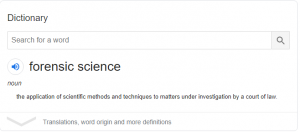
A dictionary definition of forensic science informs us that it is the application of scientific methods and techniques to matters under investigation in a court of law. With that established, we can continue.
When was the beginning?
Throughout history, people have tried to match a criminal to a crime, particularly the crime of murder.
How do we pick a point for the start of Forensic Science? Do we choose the early twentieth Century with Sherlock Holmes and his fingerprints?
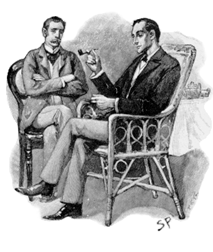
Credit:Wikicommons
Or if you have a little non-fictional knowledge of crime, perhaps you’d identify Edmund Locard, who set up his laboratory in AD1910 France. His statement of “every contact leaves a trace.” is quoted widely (Crime Museum). His idea was that mud caught in the pattern on the sole of boots can be matched to a footwear mark left in the woods near a crime.
None of these.
It’s far earlier than that
The first recorded autopsy, that we know of, happened in 44BC when Julius Caesar was assassinated (Campbell, 2020).
After the Roman Empire collapsed Dark Age Europe still wanted to punish criminals. Picture this: A priest chants the liturgy over a body laid on a bier. Around him, mourners wail their grief. The congregation parts and two burly men with swords drag an unwilling third man between them. They stand him before the body. The captive attempts to squirm away, almost as if he thinks the body will jump up and accuse him. He is held securely. The guard on the right grabs the captive’s hand and forces it towards the body. The captive breaks down and confesses to killing the victim.
Why? In 6th century Germany, an epic poem records how blood flows from the wounds of Siegfried Dragon Slayer when his murderer approaches his bier (Englehaupt, 2017). Belief in Cruentation continued until the 17th Century. Before the collection and interpretation of evidence, trial by ordeal was the way to obtain a confession for a crime (Brittain).
Pick Your Poison
It wasn’t only Europe where crime and punishment were important. In AD1247 in China. Song Ci, a Chinese official, discussed insects as a way of solving crime (McDermid, 2014). He wrote the first Forensic Text Book, Washing Away of Wrongs. Inside, he instructed law enforcers on the proper method to detect death by poison.
…take a silver needle, wash it in lye made from the soap bean and insert it into the dead man’s mouth, sealing up the mouth tightly with paper. After a little while take it out, and you will find it of a dark blue or black color, which will not come off if washed again with soap-bean lye. If it is not a case of poison the needle will remain fresh and white. (Hall, 2010)
Arsenic was the poison of choice for the discerning murderer, as the effects resemble cholera (Worsley, 2013). However, in Sweden AD 1775, Carl Scheele developed a method to detect arsenic.

Arsine gas, which smells of garlic, would evolve from the reaction.
In AD 1787, Johann Metzer refined the method, producing a precipitate. The Arsenic Mirror, a reflective black powder, would form in the presence of Arsenic (ChemEurope.com).
From there, James Marsh (England AD 1836) refined his Marsh Test, allowing scientists to determine if arsenic was present in a victim’s body (Worsley, 2013).
Father of Forensic Chemistry
The true ‘Father of Forensic Chemistry’ emerged in Spain. Chemist, Matthieu Orfila wrote the paper ‘Traité des poisons tirés des règnes minéral, végétal et animal; ou, Toxicologie générale’ in AD 1814. In addition, he was the first person to study blood and semen stains under a microscope (National, 2014).
Credit:Wikicommons
Face the Music
The first English forensic case, in 1794, involved a piece of paper used to tamp down a charge in a muzzle-loading gun. The paper stuck in the brain of the victim; the murderer ripped it off a song sheet the police found in his pocket (McDermid, 2014)).
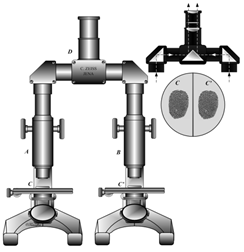
In 1835 bullets were made in individual molds kept by the gun owner. A Bow Street Runner solved a crime by matching a bullet from the scene of a crime to a mold and the criminal (McDermid, 2014). This ability to match bullets to guns became even easier when US Colonel Calvin Goddard invented the comparison microscope in 1929 (image 4) and helped solve the St Valentine’s Day Massacre in Chicago. It is good for examining fingerprints as well (Primidi.com).
Case Study: The OJ Simpson Trial
The Los Angeles Police Department has a long history of Forensic Science starting with the foundation of their laboratory in 1923. But in 1994, it all went wrong.
The police arrested OJ Simpson for the suspected murder of his ex-wife, but when it came to trial the Defence Attorneys highlighted all the flaws in the evidence collection, and Simpson was acquitted.
- One officer carried a vial of Simpson’s blood onto the crime scene without logging it as evidence. The defense team argued that it could have been used to plant evidence (Associated Press).
- 5mL of blood from the vial was ‘missing’ (Crime Museum, 2021).
- Evidence was not routinely documented, relying on the memory of those who had collected it.
- Evidence was incorrectly stored, leaving their samples in a vehicle on a hot day.
- Chain of Custody was not maintained.
- Anyone could walk onto the crime scene (Aizman, 2022).
- The new (at the time) DNA evidence was not couched in terms that the jury could understand (Crime Museum, 2021).
No one can say if the correct procedures would have led to a different verdict. What this mess did lead directly to is the shake-up of the forensic service. Now, no CSI will enter a crime scene without protective gear to prevent accusations of contamination. All evidence collected is documented and a chain of custody is implemented. Entry to crime scenes is carefully controlled. All of this came about because of the mistakes made in the OJ Simpson case.
Failures in correct procedures still happen, but only rarely.
Finally
This is just a brief history of where Rex Welsh found his Forensic Tests. But hopefully, it helps illuminate some of the darker corners. Forensic Science is an essential part of solving crime. Police interview witnesses and the most important witness is the Crime Scene.
Forensic Science gives the crime scene a voice.
Images
Forensic Science definition Google search: https://www.google.com/search?client=opera&q=defintion+of+Forensic+science&sourceid=opera&ie=UTF-8&oe=UTF-8 accessed 06/06/2020
Image of Sherlock Holmes from Wikicommons
Image of comparison microscope from https://commons.wikimedia.org/wiki/File:ComparisonMicroscope.png
Arsenic Equation from https://www.chemeurope.com/en/encyclopedia/Marsh_test.html
References
Aizman, D. (2022) Lessons Learned from the Evidence Gathering Mistakes In Simpson Case. Aizman Law Firm. https://aizmanlaw.com/lessons-learned-evidence-gathering-mistakes-simpson-case/
Associated Press. (2017, updated). OJ Simpson Simpson Case Taught Polioce What Not to do at a Crime Scene. Los Angeles Daily News. https://www.dailynews.com/2014/06/08/oj-simpson-case-taught-police-what-not-to-do-at-a-crime-scene/
Brittain, R.P. Cruentation in Legal Medicine and in Literature. Notes and Queries. NCBI. https://www.ncbi.nlm.nih.gov/pmc/articles/PMC1033446/pdf/medhist00156-0094.pdf
Campbell, M. & Robertson, H. (2020, Nov 11). The Entire History of Autopsy. Popular Mechanics. https://www.popularmechanics.com/science/health/a25633042/autopsy-history/
ChemEurope.com. Marsh Test. Encyclopedia. https://www.chemeurope.com/en/encyclopedia/Marsh_test.html
Crime Museum LLC. Edmund Locard. https://www.crimemuseum.org/crime-library/forensic-investigation/edmond-locard/
Crime Museum LLC. (2021). Forensics at the OJ Simpson Trial. https://www.crimemuseum.org/crime-library/famous-murders/forensic-investigation-of-the-oj-simpson-trial/
Engelhaupt, E. (2017, Oct 9). How ‘talking’ Corpses were once used to solve murders. National Geographic. https://www.nationalgeographic.com/science/article/how-talking-corpses-solve-murders-cruentation-ordeal-science
Hall, M.C. (Ed.) (2010). Washing Away of Wrongs: Song Ci. Translated by Herbert A Giles. Lulu books.
Los Angeles Almanac.(© 1998-2019). America’s First Crime Lab. Given Place Media, publishing as Los Angeles Almanac. http://www.laalmanac.com/crime/cr720.php
McDermid, V. (2014) Forensics: The Anatomy of Crime. Profile Books Ltd.
National Library of Medicine. (2014 June 05). Biography of Mathieu Joseph Bonadventure Orfila. https://www.nlm.nih.gov/exhibition/visibleproofs/galleries/biographies/orfila.html
Primidi.com. Comparison Microscope – Notable cases – St Valentine’s Day Massacre. https://www.primidi.com/comparison_microscope/notable_cases/st_valentines_day_massacre
Worsley, L. (2013) A Very British Murder. BBC Books.