Finger prints are the clear images created under controlled conditions, such as when the police take fingerprints at the police station. Fingermarks are the smeary, partial prints that are found at the crime scene. The hard part is comparing the two.
To solve this problem, Dr Henry Faulds created his classification system in the 1870s and it is still in use today. Each person has a combination of these patterns, such as forks, whorls and arches (image 1). This creates the individual patterns that so far are not replicated, even with identical twins.

Image 1: Classification system of patterns, Henry Faulds, 1905. Wellcome Collection. In copyright
Sir Francis Galton added to these patterns by identifying minutiae in his 1892 book Finger Prints (Findlaw, 2019). With the rise of automated fingerprint recognition systems these minutiae increase the sensitivity of matches. When studied under a microscope ridge endings, island dots and other patterns jump out at the examiner (image 2). Coupled with minutiae, the Faulds classification system allows the courts to set a minimum agreed upon number of points that correlate. In the US a fingerprint expert testifying in court that the smeary marks found at the scene match the carefully taken prints from the station must find 12 similarities of patterns and minutiae or he cannot state there is a match (Boyd, 2009).
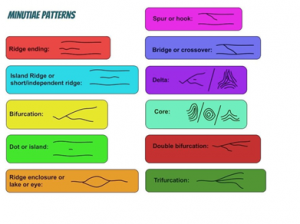
Image 2 from Wikicommons (unchanged)
The problem with fingerprints is they are often invisible to the naked eye (i.e. latent). Investigators have invented clever techniques to bring them into view.
Enhancement Techniques
Silver Screen
The oldest method of fingerprint analysis is the use of silver nitrate. On exposure to sunlight the white silver nitrate, bound to the Chloride in the latent fingerprint, turns black. However, after about a week details in the fingerprint are lost, making it difficult to create a long-term fingerprint data base. It is no longer in use (Australian Police, 2021). As a treatment it also reduces the possibility of collecting touch DNA samples (Sodhi et al. 2015).
There are a number of methods of enhancement, including gold plating (Newland et al) but the two main methods of enhancement in current use are Ninhydrin dye and Cyanoacrylate Fuming.
Pretty in Pink
For fingerprint analysis, Ninhydrin dye reacts with the ammonia and primary and secondary amines in the sweat residue of fingerprints. Ninhydrin can be used to enhance fingerprints on both porous and non- porous surfaces., but is considered the best treatment for enhancement of latent prints on porous surfaces and for old fingerprints (Australian Police, 2021). Touch DNA can be collected after treatment with Ninhydrin, but there have been doubts raised about the quality of DNA (Angslinger et al, 2004).
Sticky Fingers
In addition to Ninhydrin dye there is super glue. In the late 1970s, the US Army discovered that Cyanoacrylate or superglue reacts with the moisture in a fingerprint on a hard surface and creates a hard coat over the mark, a poorly funded department’s gold plating, protecting it from accidental erasure. The process has to be done in a laboratory as the process requires a fuming cupboard; this allows large numbers of items to be processed at the same time (Penven, 2015). The best part is the hard coat protects any touch DNA left behind in the mark (Larsen, 2020).
Glowing colours
While Ninhydrin dye and cyanoacrylate are the most common methods of enhancement, there is another way: fluorescent dyes. Criminals know to wipe down a scene, but there is a fluorescent polymer that attaches to the smallest trace of blood and illuminates a fingerprint while not destroying any DNA evidence (American Chemical Society, 2021)
All those are laboratory techniques for enhancing latent prints, increasingly fluorescent fingerprint powders can be used at the crime scene to dust for fingerprints which are then illuminated by an alternative light source (Spex Forensics).

Image 3: from wikicommons
Criminals may use detective fiction to teach themselves how to tidy-up after their crime, but the methods are still evolving to allow crime fighters to keep ahead in the race for Justice. Alternative light sources can be used for so much more than just fingerprints, but I’ll talk about that another time.
How good are you at fingerprint analysis? click on the link to a quiz and find out.
https://www.opinionstage.com/vanessa-knipe/how-good-do-you-think-you-d-be-at-fingerprint-analysis-
Images
Cover image: from Wikicommons
Image 1: Classification system of patterns, Henry Faulds, 1905. Wellcome Collection. In copyright
Image 2: from Wikicommons (unchanged)
Image 3: from Wikicommons
References
American Chemical Society. (2021, April 21). Illuminating invisible bloody fingerprints with a fluorescent polymer. ScienceDaily. Retrieved November 9, 2021 from www.sciencedaily.com/releases/2021/04/210421124525.htm
Anslinger, Katja., Selbertinger, U., Bayer, Birgit., Rolf, Burkhard., Eisenmenger, W., (2004) Ninhydrin treatment as a screening method for the suitability of swabs taken from contact stains for DNA analysis. International journal of legal medicine 118. https://www.researchgate.net/publication/8511326_Ninhydrin_treatment_as_a_screening_method_for_the_suitability_of_swabs_taken_from_contact_stains_for_DNA_analysis
Australian Police. (2021). Chemical Detection Techniques. australianpolice.com.au. https://www.australianpolice.com.au/dactyloscopy/fingerprint-detection-and-enhancement/chemical-detection-techniques/
Boyd, A. (2009) No.2529 Comparing Fingerprints. [on the University of Houston website Engines of Our Ingenuity]. https://www.uh.edu/engines/epi2529.htm
FindLaw Team. (2019, Feb 14) Fingerprints: The First ID. https://www.findlaw.com/criminal/criminal-procedure/fingerprints-the-first-id.html
Larsen, J.L., (2020, Jul-Aug) DNA, Latent Prints, & Contamination. Evidence Technology Magazine. https://read.nxtbook.com/wordsmith/evidence_technology/august_2020/dna_latents_contamination.html
Newland, TG., Moret, S., Bécue, A., and Lweis, SW. Further investigations into the single metal deposition (SMD II) technique for the detection of latent fingermarks. Université de Lausanne. https://serval.unil.ch/resource/serval:BIB_4BDD7585AC3F.P001/REF
Penven, Don. (2015, Feb 27) Developing latent prints with super glue. Crime Scene Investigator. https://www.crime-scene-investigator.net/cyanoacrylate-fuming-a-mainstay-of-crime-scene-investigation.html
Sodhi, Parveen., Gupta, Ritika., Singh, Rajinder., Jasuja, O P. (2015) – Effects of Latent Fingerprint Development Reagents on Subsequent Forensic DNA Typing: A Review. Journal of Forensic and Legal Medicine 39. https://www.researchgate.net/publication/273480256_Effects_of_Latent_Fingerprint_Development_Reagents_on_Subsequent_Forensic_DNA_Typing_A_Review
Spex Forensics. Latent Fingerprint Detection. https://spexforensics.com/applications/latent-fingerprint-detection