If you are interested in South Korea, you most probably have your favorite K-pop group and a K-beauty brand. You have probably eaten in a Korean BBQ restaurant and tried soju. But — have you experienced the culture of Jjimjilbang?
What is Jjimjilbang?
I came across the word Jjimjilbang (pronounced tchim-jil-bang) when looking up “things to do when in Seoul”. A Jjimjilbang is a Korean sauna. There are thousands of them dotted around the country, and the idea of visiting one of them was, to say the least, very intriguing.
1. It is not just a sauna
To say that it is a “Korean sauna” might be a bit too simplistic. When translated to English the word means “hot-steaming rooms”. Using the word “public bathhouse” does not pay sufficient tribute to this cultural creation that has become quite popular in Korea since the early 2000s.
 Before, Koreans would visit saunas and public baths, but none of the places offered as much entertainment as the Jjimjilbangs. Jjimjilbangs are located in multiple-story buildings. Apart from steam rooms, saunas, bathtubs, and treatment rooms, you will find restaurants, snack bars, TV rooms, sleeping rooms, and much more.
At the heart of every Jjimjilbang is a construction that looks similar to a pizza oven or a stone igloo. It’s a traditional kiln sauna that brings back the history of the sauna culture in Korea. These constructions that you can find in a modern Jjimjilbang are smaller copies of clay kilns used in charcoal production. The temperature inside the sauna can reach up to 200 degrees celsius. The air is so hot that it feels like your nostrils will burn. Koreans firmly believe in the healing power of both clay and high temperatures. Apparently, these have cured people suffering from arthritis or cancer.
These claims might feel overly exaggerated but it is not a mystery that a dry sauna has numerous benefits on the body. Apart from physiological benefits, a session in a dry sauna can lower anxiety and boost one’s mood. This is something that I can’t argue with because the atmosphere in the Jjimjilbang on a Friday is magical. Korean women are quietly whispering to each other, the warmth of the floors in the Jjimjilbang makes me feel very relaxed and sleepy.
2. It’s a great sleeping place!
What makes a Jjimjilbang so different from any other sauna experience is the fact that you can sleep there. The entrance ticket usually covers around 8 hours of stay. Jjimjilbangs are open throughout the night, making them a perfect place for a lone tourist who wants to sleep but can’t afford a hotel room. This is a real bonus, especially if you want to stay in a fancy part of Seoul, such as Gangnam.
Even though Jjimjilbangs are generally quiet, the splash of water, TV rooms and big groups of women do tend to puncture the silence sometimes. For this reason, every Jjimjilbang has a separate room with dimmed light, simple mats, and blocks scattered around. The blocks are there to serve you as a pillow and your bathrobe is your blanket. Even though you sleep on the floor, the quality of sleep is amazing and you feel extremely comfortable and safe.
3. It’s for everybody
A typical jjimjilbang is an establishment open to everyone. Men and women have separate bathing areas, but they can hang out in common areas, entertainment rooms, and restaurants. Around Seoul, you can find plenty of jimjilbangs that are for women only, and this was something that I chose.
A visit to a jjimjilbang is a ritual not only for a group of friends but also for families. You can go to a jjimjilbang with your work colleagues but only if you know them well enough. It is certainly not a place that you go to with someone you’ve just met. It’s a beautiful bonding experience between a mother and a daughter and an opportunity for a discreet “check” on the future daughter-in-law if invited by the mother-in-law.
4. Boiled eggs and rice drink on the menu
 Your jjimjilbang experience will not be complete if you do not fold the towel over your head in a shape that brings to mind a sheep head. It is not easy and I spent a good hour learning with a YT video. They look super cute but their main purpose is to keep the sweat away from your eyes.
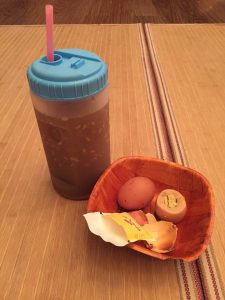
The must-try food in a jjimjilbang is a boiled egg and a rice drink. Eggs are prepared in the same place where you sweat the most – the kiln sauna. Because of the high temperature and longer cooking process, the eggshells have a darker color and the eggs taste different. The egg white is denser, giving it a very distinct flavor. It is usually accompanied by a cold and sweet drink called Sikhye.
You might have seen Sikhye (pronounced shik-keh) in pictures — a drink it is always served in a plastic cup with a blue top. The light brown colour reminds me of ice tea with the difference that you will find bits of rice floating around. Sikhye is made from fermented rice and malt water with added sugar. It has a very distinct flavour that is reminiscent of kombucha. As with all fermented drinks and food, it is really good for digestion and I suppose this is why it has found its place on the menu of a snack bar in a jjimjilbang.
Jjimjilbangs usually have a restaurant serving traditional Korean food and a terrace outside where you can get some fresh air.
6. Final thoughts
Jimjilbangs should be on the top of your list if you are a fan of unwinding on your holiday. With all the options and services that a jjimjilbang can offer, it is an inexpensive way to relax and enjoy the true Korean experience. One thing that I particularly liked is the fact that you can use a jjimjilbang for women only. I’m not a fan of sharing such spaces with men, which is usually the normal thing in a Finnish-style sauna in Europe.
Oh, and you do not need to go to Korea to visit a jjimjilbang. Jjimjilbangs are very popular in New York. Hopefully, soon we will get them around Europe too!
References:
- Smith, M.& Puczko, L., (2009). Health, Tourism and Hospitality: Spas, Wellness and Medical Travel. Elsevier.
- Hayasaka, S., Author, Yosikazu, N., E. Kajii, Masahiro I, (2008). Effects of charcoal kiln saunas (Jjimjilbang) on psychological states. Complementary Therapies in Clinical Practice (2), pages 143-148. https://www.sciencedirect.com/science/article/abs/pii/S1744388107000850
- Byung-min Oh, J. Hyun-Il, HyeonHwa Oh, Seung-Wha J., et al. (2020). Quality Characteristics and Functional Evaluation of Sikhye Fermented by Lactic Acid Bacteria. Journal of the Korean Society of Food Science and Nutrition (8), pages 803-813. https://www.e-jkfn.org/journal/view.html?uid=6774&vmd=Full
- Kiln Saunas Make a Comeback in South Korea. The New York Times. (15.09.10). https://www.nytimes.com/2010/08/27/world/asia/27iht-kiln.html
- Roh, J. (2017). Essential Korean Reader. Routledge.


