As a headline, Intel Admits What We All Knew: No One is Buying AI PCs, has a lot to say about modern computing (Roach, 2025). In fact, the term AI is misleading, it’s just sophisticated programming, not intelligence (Mitchell, 2025). In certain areas, these so-called AI work well. When trained on specialised data sets, the programmes, that I prefer to call Expert Systems, are brilliant at tasks such as fingerprint recognition, as I mentioned in this article. But generative AI is trained on ideas already in existence, not new research. These out-of-date data sets make it difficult to see how it will create new ideas (Newitz, 2025). And then, we hear so much about quantum computing, and all the advantages that will bring. But let’s forget quantum and laser computers, they use up valuable resources, electricity and water, but fail to fulfil their potential. At present, what we are trying to do is make rocks think (Evans, 2020). And anyone who reads Sir Terry Pratchett’s Discworld books knows that the silicon-based lifeforms, known as Trolls, are not smart[i]. In this month’s paddle in the backwaters of science, let’s move away from trying to teach rocks to think, and imagine an alternative future of computing.
Definitions
Google dictionary tells us that a computer is “an electronic device for storing and processing data, typically in binary form, according to instructions given to it in a variable program.”
However, before 1935 a computer was a person who undertook mathematical calculations. The definition changed between 1935 and 1945 (Montecino, 2010). For the purposes of this article, we will use the post-1945 definition of a machine.
What other options for computing are there?
Science Fiction writers often lead the way. Douglas Adams pictured a computer that was an entire planetary ecosystem.
‘I speak of none but the computer that is to come after me,’ intoned Deep Thought…

“And it shall be called . . . The Earth.’ ~ The Hitchhiker’s Guide to the Galaxy by Douglas Adams. (Adams, p. 148).
And Sir Terry Pratchett envisions a computer based on ants, with his label the case of ‘Anthill inside’. So, does an organic computer have any basis in reality?
Organic Computing
Well, yes. The best computer we know is the organic brain of humans. Even other mammals have brains with far superior capacity to the mineral-based machines we currently use. So, perhaps for an alternative future of computing we should be thinking about more organic processing methods.
Maybe, these bio-computers will not use higher organisms, like ants, but organic computing has some serious research behind it.
Bacterial Computing
Since the year 2000, a branch of science called synthetic biology has risen in prominence. It studies the biological computing idea (How, 2023). The trick is in DNA, which are the instructions to create enzymes, and enzymes change one protein into another. Using specific strings of nucleotides, in the place of binary code, programs are written to create novel enzymes (Schaffter , 2022).
When given one chemical stimulus the bacterium produces one protein, but with a different stimulation a second protein is produced. No different from a computer instruction of if…then.
Two main advantages of living organisms are growth and evolution. Most bacterium reproduce exponentially. During cell division, there are sometimes mutations. If even one of these mutations solves the problem, then it can be isolated. Once a bacterium has evolved to perform the correct action, then scaling up is simply a matter of reproduction (Lahoz-Beltra, 2014). Image 3 shows E. coli bacteria dividing.
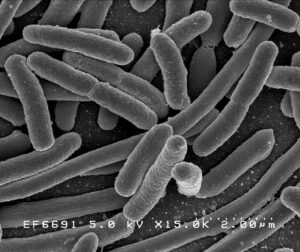
Credit: NIAID, Public domain, via Wikimedia Commons
With mineral computers there is a written program and one computer. The bacteria write their own program, by evolution, to solve the problem and can be engineered to glow when the pathway is correct, making the useful bacterium easier to pick out of the petri dish (How, 2023). Quick easy solutions, grown in a laboratory.
There are currently applications available on bio-computers that help with genomics and personalised medicine (Welcome, 2021). While creating actual DNA and RNA circuits, rather than bacterial computing, is still a theoretical process being designed on the mineral computers, it is an exciting field of study (Schaffter , 2022).
And bacteria are not the only problem-solving, single-celled organisms.
Slime mould Computer
DNA and RNA circuits are being researched, but what if we could just grow circuits for our computers? How about Slime Moulds? A slime mould can track the best route between food sources and send out protoplasmic tubes to transport the nutrients to the main portion of the cell, as seen in image 4. When coated on a chip, a slime mould could form a bridge between human and mineral prosthetic devices, making them more efficient (Merrifield, 2015).

Credit: Rob Cruickshank, CC BY 2.0 <https://creativecommons.org/licenses/by/2.0>, via Wikimedia Commons
Slime moulds are the perfect tool for the job. If you pass a current through a slime mould, it will contract. This contraction happens in exactly the same way each time the same voltage passes through it. And, it will remain in position until a new current is applied, acting as a memristor (Carboni, 2013).
In another experiment, by placing food in the right places, a slime mould grew into an efficient map of the Tokyo underground system. Not only can a slime mould optimise pathways between food sources, it also responds to light stimuli by retreating, providing a way to direct the mould’s growth on demand (Sander Effron, 2018). If metal particles are added to the slime mould, when the protoplasmic tubes grow out, they will print the circuit of that optimal pathway (Carboni, 2013).
If you think this is a solely theoretical application, the University of Chicago reports that a slime-mould-powered smart watch already exists, designed to measure the wearers heart rate. Instead of a battery, this watch is powered by feeding oats and water to the slime mould. According to researchers, wearers of the device, tended to name them and grow attached to their smart watches, as if it was a pet (Belek, 2022).
Additionally, researchers at the University of Plymouth, UK, hooked up a slime mould bio-processor to a piano. When someone plays a tune on the instrument, the bio-processor will play back variations on the tune — the bio-processor has learned (Miranda, 2020).
Conclusion
There we have it. Research is already advanced into the search for an alternative future for computing. Instead of mineral computers with no personality, we could be growing computer pets in the laboratory to handle everyday tasks, They run faster than our current computers and use far less in the way of resources. As long as we don’t develop a hyper-intelligent slime mould, which objects to its less intelligent cousins being plied with electricity, the future of organic computing looks bright. But in the meantime, our computer experts remain focused on trying to get rocks to think.
References
Adams, Douglas. The Hitchhiker’s Guide to the Galaxy: The 42nd Anniversary Edition of Douglas Adam’s International Bestseller. Pan Macmillan. Kindle Edition.
Belek, C. (2022) Users have to feed Tamigotchi-like device in human computer interaction experiment. UChicago News. Dec 13. https://news.uchicago.edu/story/scientists-create-living-smartwatch-powered-slime-mold
Carboni, A. (2013). Living Computer Created with Slime Mould. Seeker, YouTube. Jun 25. https://www.youtube.com/watch?v=HKZ2LtfDrmg
Evans, C. (2020). Our Computers Are Limited by their Rock-Based Architecture. Massive Science. Sept 29. https://massivesci.com/articles/slime-computers/
How a Bacteria Colony Outwitted Computers by Evolving. (2023) NanoRooms, Youtube. https://www.youtube.com/watch?v=Gp1eolf8M_U
Lahoz-Beltra, R., Navarro, J., & Marijuán, P. C. (2014). Bacterial computing: a form of natural computing and its applications. Frontiers in microbiology, 5, 101. https://doi.org/10.3389/fmicb.2014.00101
Merrifield, R. (2015)/ Growing Computer Chips from Slime Mould and Bacteria. Horizon. Feb 16. https://projects.research-and-innovation.ec.europa.eu/en/horizon-magazine/growing-computer-chips-slime-mould-and-bacteria
Miranda, E. (2020). Bio-processors — Creating electrical components from slime mould. University of Plymouth, YouTube. Sept 15. https://www.youtube.com/watch?v=OCbxOoRmNak
Mitchell, I. (2025). Is AI really Intelligent? 6POINT6. https://6point6.co.uk/insights/is-ai-really-intelligent/
Montecino, V. (2010). History of Computing. Education and Technology Resources. Nov. https://mason.gmu.edu/~montecin/computer-hist-web.htm#:~:text=Definition%20of%20a%20Computer%20-%20before,machine%2C%20rather%20than%20a%20person
Newitz, A. (2025). Life in the Fast Lane. New Scientist. 8 February.
Roach, J. (2025). Intel Admit What We All Knew: No One is Buying AI PCs. XDA. April 25. https://www.xda-developers.com/intel-admits-what-we-all-knew-no-one-is-buying-ai-pcs/
Sander Effron, S. (2018) Slime Mould Can Solve Exponentially Complicated Problems in Linear Time. SCI NEWS. Dec 26. https://www.sci.news/biology/slime-mold-problems-linear-time-06759.html
Schaffter, S W., and Strychalski, E A. (2022) Co-transcriptionally encoded RNA strand displacement circuits. Science Advances. March 23. DOI: 10.1126/sciadv.abl4354
Welcome to the BioComputer. (2021) BiologIC Technologies. Dec 8. https://biologic-tech.com/welcome-to-the-biocomputer/#:~:text=BiologIC%20is%20developing%20the%20world%27s,a%20revolution%20in%20biology%20processing
[i] “Detritus’s intelligence wasn’t too bad for a troll, falling somewhere between a cuttlefish and a line-dancer, but you could rely on him not to let it slow him down.” ~ Jingo by Sir Terry Pratchett