(Maya Hieroglyphs. Credit: Wikisource)
Mayan astronomy
Maya believed the earth to be fixed and at four corners, according to the cardinal directions. Other celestial phenomena like planets, sun, stars, and moon were conceived as gods traveling. They also thought that these gods were involved in human affairs. The sun was perhaps the most important goddess of the Mayan Pantheon. His name was Kinich Ahau, a descendant of Itzamna, one of the Mayan creator gods. Every day Kinich Ahau shines bright in the sky, and then it descends into the underworld at night, to rebirth again next day. Therefore, Mayas discovered the solstices and equinoxes by looking at the sun movements. The moon was important as much as the sun. The Maya moon goddess was Ix Chel, who fights every night against the sun to force him to descend into the underworld. Planets and Venus have been tracked as well. Venus year was calculated to be 584 days long, close to the 583.92 days estimated by modern science.
The Calendar System
Maya did not invent calendar, but they developed one of the most accurate and refined calendar system in human history. Their revisitation was accepted by several cultures in Central America and is still relevant today in Guatemala, Belize, Honduras, El Salvador, and parts of Mexico. The Mayan calendar consist of three interlacing calendars, which moves simultaneously as three wheels working together. The three calendars are: the Long Count, the Tzolkin (divine calendar), and the Haab (civil calendar). Each wheel is cyclical (see picture). The Haab is long 365-day solar, divided into 18 months of 20 days each; one month is only 5 days. This 5-days month is called Uayeb. Each month is represented using more than one glyph, displaying the personality associated with the month. The Tzolkin calendar is also called the Divine Calendar or Sacred Round. It is a 260-day calendar divided into 20 periods and was used to plan religious and ceremonial events. The Long Count is an astronomical calendar which tracks longer period of time, each of 7885 solar years.
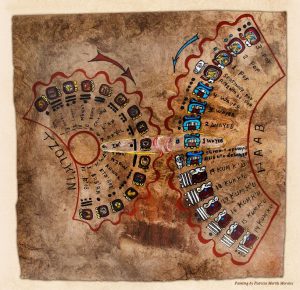
(The wheels working together. A painting by Patricia Martìn Morales)
ANCIENT MAYA COSMOLOGY TODAY
Although Maya were a pre-telescope society, they were expert astronomers and their calculations are extremely precise and correct. For instance, they were right about the estimate of the length of the synodic month, as well as about the length of the tropical solar year. It has been precisely the Long Court calculation the cause of 2012 hysteria about the end of the world. The Long Court sets really an end date, but Maya believed that the universe is destroyed and then recreated. The 2012 phenomenon is due to a wrong and incomplete interpretation of Maya’s concept of cycle of life, causing the confinement of their system of thought to the esoteric sciences.
References
W. Nahm, Maya warfare and the Venus year“, Mexicon, V. 16, 1994.
Website link: https://www.irishtimes.com/news/science/a-link-between-physics-maths-and-the-mayans-1.2162917
Website link: https://www.timeanddate.com/calendar/mayan.html
Website link: https://maya.nmai.si.edu/calendar/maya-calendar-converter