Drugs create a major portion of the work for a Forensic Chemist. Both legal and illicit drugs cause problems that require the attention of Law Enforcement agencies. Until recently detecting these in a person required invasive techniques and a medical practitioner to take blood or urine samples. However, these tests cannot be performed at the point of contact. What law enforcement requires are ‘roadside’ systems, such as the breathalyzer test used for alcohol. So here is a whirlwind history of the current progress in the development of systems for rapid detection and analysis of drugs.
What’s New in Analysis?
From the amount of advertising New Scientist magazine promoted on social media platforms about the novel MagLev technique for in-field separation of illicit drugs one might expect it to be a major article. That was not the case. The article appeared as a few paragraphs at the bottom of page 6 of the January 4th issue. The technique separates the drugs by density, with the small size of the equipment meaning it ‘could prove useful to law enforcement’ (Murugesu, 2020). The authors of the original paper, from which New Scientist created their synopsis, describe their technique as using very small amounts of diamagnetic crystals or particles (drugs) and relatively inexpensive and reusable equipment to get a gradient separation using a paramagnetic solution and like to like magnetic poles (Abrahamsen, 2020). It can be used to detect up to seven substances with different densities. Most helpfully, the test is non-destructive and the separated substances can be extracted for further confirmatory testing.
Which Body Fluids are best for Detecting taking Drugs and Driving?
Breathalyzer
Credit: https://commons.wikimedia.org/wiki/File:Transportation_Systems_Center_Staff_Member_Demonstrates_Alcohol_Breath_Analyzer_-_NARA_-_6882630.jpg
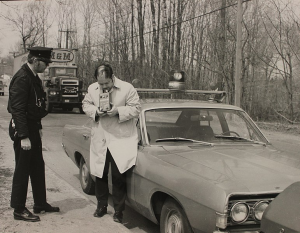
One of the main areas of drug testing for law enforcement is for the area of Driving Under the Influence. Blood testing cannot be done at the point when a police officer has stopped a car. Previously, breathalyzer tests were used only for alcohol but a University of Pittsburgh paper announced a breathalyzer for marijuana, using carbon nanotubes thinner than a hair. They report that their prototype detection device is equivalent to the ‘gold standard’ of Mass Spectrometry for tetrahydrocannabinol (THC). As above, the small-sized equipment makes it usable by a police officer in the field (Hwang, 2019).
Gold Standard
Mass Spectrometry has long been considered the Gold Standard for the detection of drugs, with a result compared to a computerized library of pristine substances. All analytical methods are compared to this method. However, drugs found in the community are rarely pure so the adulterants can create an error in identification (Gin, 2018).
Saliva
Other methods of roadside detection have been trialed. Saliva is also possible to collect without awkwardness on the part of the officer or the individual being tested. In some cases, it provides a better correlation between drug use and being under the influence than finding drug metabolites in the urine. It is particularly useful for cannabis and benzodiazepines, but cocaine and heroin were also detected (Versraete, 2005).
Immunoassay
Another study by researchers at the University of Glasgow reveals that one-third of people under the influence can pass Roadside Impairment Tests, such as walking in a straight line. However, a simple immunoassay kit, the Cozart RapiScan system, is presented as a solution. It is similar to a pregnancy test kit and provides a permanent printout, useful for a Court of Law (Carlin, 2009).
Colorimetric
Colorimetric presumptive tests for drugs can lead to false positives due to individual determination in interpreting the color change in the spot testing kits. This is of concern because high levels of Los Vegas police department convictions were dependent on unreliable kits (Gabrielson, 2016). A more modern version of colorimetric testing has been developed. The tests are performed on a rotation-driven, micro-fluidic device and the color change is checked by the user’s smartphone. Multiple reaction chambers on the platform allow for duplicate testing from one injection of the suspect material, and the use of a smartphone allows an easy-to-follow, objective reading of any color changes (Krauss, 2016).
Animal versus Electronic ‘noses’ in Detection

Credit: https://commons.wikimedia.org/wiki/File:Chiquita,_a_bomb_detection_dog,_aboard_the_USCGC_Blackfin_-a.jpg
Tests are needed not only on the roadside, detection of drugs hidden at a crime scene is also vital. Sniffer Dogs play a vital role in the detection of drugs. In 87.7% of tests, dogs found hidden drugs within 10 minutes of initiating the search. The best breed for the search was German Shepherd dogs (Jezierski,2014). Not every force has access to specially trained dogs. A number of portable devices, ‘e-noses’, ‘e-eyes’, and ‘e-tongues’, are credited with imitating human abilities. These devices were used to test for explosives , gunshot residue, and accelerants as well as illicit drugs. As with the colorimetric tests for drugs, listed above, it was paper-based test systems that worked best, in correlation with a smartphone detection system while electronic devices still lacked sensitivity (de Oliveira, 2018).
Can Analysis of Waste Water tell us Anything?
So how widespread is drug abuse in the general population? During the Covid pandemic, several reports suggested that the virus was detectable in wastewater. This method of testing wastewater at sewage works and surface water from rivers also works for drugs or their metabolites. A solid phase extraction and high-performance liquid chromatography coupled with mass spectrometry indicate that waste water at the treatment plants had a high concentration while it was much lower in rivers. This means that excreted drug residues form a new type of environmental hazard that needed to be addressed (Castiglioni, 2008).
Credit: https://commons.wikimedia.org/wiki/File:USCurrency_Federal_Reserve.jpg
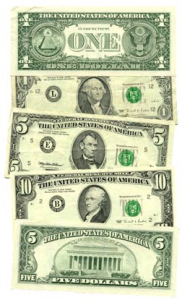
Paper currency is also a very modern area of concern for drug testing and analysis. A teaching exercise for some students using Liquid Chromatography in tandem with Mass Spectrometry revealed amphetamine, methamphetamine, and oxycodone as well as the expected cocaine (Parker, 2017).
What about Detection of the New Drugs in Constant Development?
Unfortunately, new psychoactive drugs are constantly coming onto the illicit market, requiring new methods of identification. The regular roadside colorimetric and immunoassay kits may not pick them up. So here, it is necessary to take the invasive blood and urine samples to confirm the ingestion. Ultra-high-performance liquid chromatography coupled with time-of-flight mass spectrometry outperformed immunoassay tests in urine drug testing for these novel psychoactive substances (Sundström, 2017).
Finally
And in the end, we return to the 2020 New Scientist article mentioned at the beginning of this essay, as the search for methods of identifying drugs, new and old, continues. While new methods of detection and analysis of drug are developed, the older methods are still widely accepted. Laboratory and in-field testing are complementary; each bringing much-needed clarity into the area of forensic drug testing.
References
Abrahamsen, C.K., Nargarkar A, Fink M.J., Preston D.J., Shecheng Ge, Bozenko J.S. and Whitesides G.M. (2020). Analysis of Powders Containing Illicit Drugs Using Magnetic Levitation. Angewandte Chemie vol59 January 7. pp874-881.
Castiglioni S., Zucatto E., Chiabrando C., Fanelli R. and Bagnatti R. (2008) Mass spectrometric analysis of illicit drugs in wastewater and surface water. Mass Spectrometry Reviews. July/August. Vol 27 issue 4. pp378-394
Carlin, M. (2009) Forensic Science: Roadside Drug Testing. Measurement + Control. Vol42 issue10. December 10. https://journals.sagepub.com/doi/pdf/10.1177/002029400904201003
Gabrielson, R. (2016) Unreliable and Unchallenged. ProPublica October 28 https://www.propublica.org/article/unreliable-and-unchallenged
Gin, J., and Imwinkelried, E.J. (2018). Gas Chromatography-Mass Spectrometer (GC/MS): In Scientific Evidence, Even ‘Gold Standard’ Techniques Have Limitations UC Davis Legal Studies Research Paper. (September 6) https://ssrn.com/abstract=3245423
Hwang, S.I., Franconi, N.G., Rothfuss, M.A., Bocan, K.N., Bian, L, White, D.L., Burkert, S.C., Euler, R.W., Sopher, B.J., Vinay, M.L., Sejdic, E., Star, A. University of Pittsburgh. (2019) New breathalyzer can detect marijuana. ScienceDaily.(August 27). www.sciencedaily.com/releases/2019/08/190827123239.htm
Jezierski, T., Adamkiewicz, E., Walczak, E., Sobczyńska, M., Górecka-Bruzda, A., Ensminger, J. And Papet, E. (2014) Efficacy of Fully Trained Police Dogs Varies by Breed, Training Level, Type of Drug and Search Environment. Forensic Science International. Vol 237 (April) pp112-118. https://www.sciencedirect.com/science/article/pii/S0379073814000371
Krauss, S.T., Remcho, T.P., Lipes, S.M., Aranda, R., Maynard, H.P., Shukla, N., Jingyi Li, Tontarski, R.E. and Landers, J.P. (2016), Objective Method for Presumptive Field-Testing of Illicit Drug Possession Using Centrifugal Microdevices and Smartphone Analysis. Anal. Chem. August 15, vol88, issue17, ppp8689-8697. https://pubs-acs-org.proxy.lib.strath.ac.uk/doi/abs/10.1021/acs.analchem.6b01982
Murugesu, J.A. (2020) Police Could Identify Illegal Drugs With Magnetic Levitation. New Scientist. 3263 January 4. p6.
de Oliveira, L.P., Rocha, D.P., de Araujo, W.R., Muñoz, R.A.R., Paixão T.L.R.C. and Salles, M.O.. (2018) Forensics in hand: new trends in forensic devices (2013–2017). Anal. Methods, Volv10, pp5135-5163
Parker, P.D., Beers, B. and Vergne, M.J. (2017) What Is in Your Wallet? Quantitation of Drugs of Abuse on Paper Currency with a Rapid LC–MS/MS Method. J. Chem. Educ. (August 15) vol 94 Issue 10, pp 1522-1526
Sundström, M. M. (2017) Urine Testing and Abuse Patterns of Drugs and New Psychoactive Substances — Application of Comprehensive Time-of-Flight Mass Spectrometry. Doctoral Thesis https://helda.helsinki.fi/bitstream/handle/10138/224605/urinetes.pdf?sequence=1
Verstaete, A.G. (2005) Oral Fluid Testing for Driving Under the Influence of Drugs: History, Recent Progress and Remaining Challenges. Forensic Science International. Vol150 issue2-3. (June 10). pp 143-150.