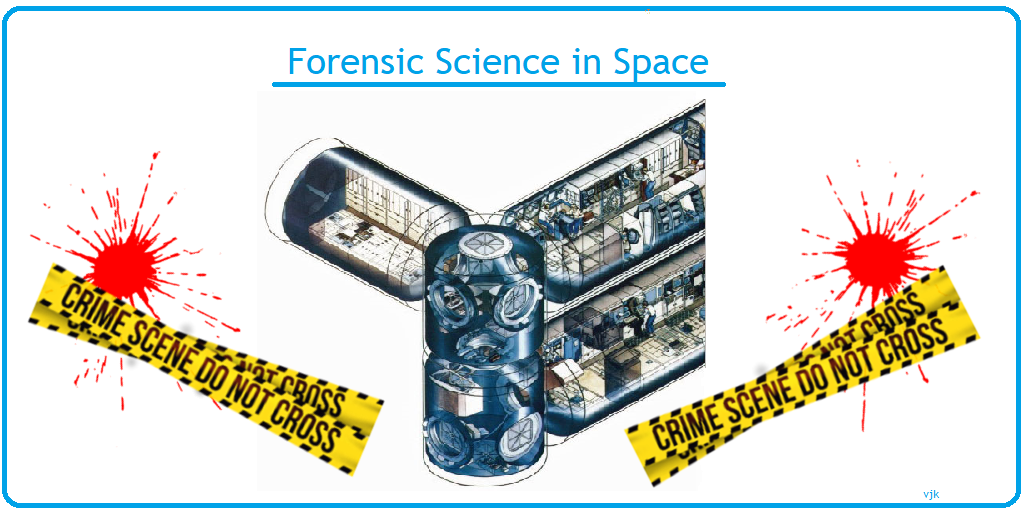
Earlier this month, August 2024, I attended the World Science Fiction Convention, Glasgow 2024. There were so many panels and lectures that it was difficult to choose which ones to attend. However, given my background in Forensic Science, two stood out that I had to attend. The first was Policing the High Frontier, and the second was There’s been a Murder: Whodunits in Space. The panellists came from varied backgrounds, one in Policing was a security expert working for the US Government, but of course, all opinions expressed in the discussion were his own and not that of his employers. The discussions covered a wide range of topics, but missed out on the most important aspect of crime investigation, how to perform Forensic Science in Space.
So what did the panellists discuss?
Policing the High Frontier had a mix of writers and security experts, while Murder in Space was a writers-only panel. Both panels took different approaches to the subject.
Policing the High Frontier
An astronaut has murdered one of his colleagues in space. It was all caught on camera as surveillance is pervasive, for safety issues. But what to do now? Everyone on board a spaceship or space station is vital for the function and safe running of the platform. With one dead, we can’t just lock the perpetrator in his cabin, we need the staff. And anyway, he’d still be eating and breathing, using up the vital supplies that are shipped, at huge expense, from Earth. Because of this, the panellists saw a need for restorative justice rather than punishment.
How do we know who deals with the case?
“Having a policing system would take away from resources.” ~ Anton Marks, Writer. (Marks,2024)
Who has sovereignty? With the future of space exploration shifting into private hands, the panellists suggested that current space law is like a Company Town with private law rather than a public police force. At present time, the only way to deal with a crime is to have the perpetrator continue with his work and then ship him back to his home country for investigation. And no one had any idea of how to deal with sentient machines that commit crimes.

As space becomes more populated these are issues that must be addressed (SJ Groenewegen, 2024).
There’s Been a Murder: Whodunits in Space
The convention programme advertised this as ‘In Space, no one can hear you scream.’ Yume Kitasei competently chaired the panel, filling in at the last moment when the original moderator could not attend. In this session, the discussion was more about why people would commit crimes rather than how to police the situation.
A murder in a space station is the classic locked room mystery. Everyone is a suspect and no one is an ally. The culture in these environments is claustrophobic, almost asking for someone to be murdered just for breathing too heavily. The small group of people remaining look at each other and wonder, who is next? And will it be me?
However, this panel actually considered forensics, if only in a negative way. In this resource-limited habitat, there is no lab to send samples to, nor are there any experts to call on to solve the crime. (Yume Kitasei, 2024)
Do we really need to consider Crime in Space?
The inclusion of a clause in the Intergovernmental Agreement on Space Station Cooperation on who deals with potential crime, suggests that officials believe it is possible. The United States has updated their Maritime Law, which covers ships on the ocean, to include a section on what happens outside any country’s influence, and that would cover space. But as Space Travel becomes increasingly commercial, with private companies entering the picture, nation-states are struggling to come up with a proper solution. After all, people are people. And the behaviour of people on Earth is going to carry on wherever they travel (Grush, 2019).
Has the first crime in space already happened?
While it is alleged that an American astronaut illegally accessed her ex-wife’s bank account during her six-month stay in space, she was cleared of wrongdoing. Was the testing of anti-satellite missiles by Russia a crime? It created a cloud of debris that endangered other satellites, but there is no international law that allows any country to complain about another country’s activities in orbit.
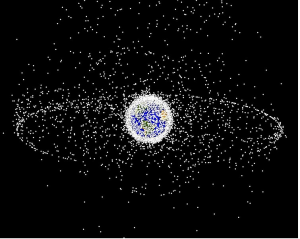
At present, there are no convictions for crimes in space (Public Affairs Office, 2021).
Is Anyone Considering Forensic Science in Space?
Even though there are no specific laws at the current time, people are looking at Forensics in a microgravity environment. The definition of Forensic Science is the application of science to be used in a court of law, a discussion of this can be found here (https://mozartcultures.com/en/a-brief-history-of-forensic-science/ ). Teams from the University of Hull and Staffordshire University, both in the UK, are working with Zack Kowalske, a Crime Scene Investigator from the USA who is reading for a doctorate. Together they are studying the action of microgravity on blood splatter analysis (Kowalske, 2024).
How does the Science Work?
The action of blood splatter in regular Earth gravity is well studied, and you can read more here (https://mozartcultures.com/en/writing-on-the-wall-reading-blood-splatters/ ). Also, the action of liquids in space is well known. Under gravity, a liquid takes the shape of its vessel, but in the microgravity environment of space, only surface tension provides the shape creating a sphere. Once the liquid hits a surface it spreads out and clings (ASDC, 2022).
So would blood act in the same way as another liquid?
To be clear, no one has flung blood around in space. That would cause a health and safety nightmare. The researchers created a mixture of 40% glycerol and 60% red food colouring to mimic the viscosity of human blood (Williams, 2024). To test their theories, the researchers booked time on the Boing 727 parabolic aircraft, which gives roughly 22 seconds of microgravity in each parabolic arc (Kuh, 2016). Even this limited time gave researchers information on blood splatter.
Kowalske squirted the syringe of the coloured glycerine at a surface. The blood splatter patterns differ from those on Earth, because, as mentioned above, liquids stick to their landing site. The shape of the blood droplet was spherical, rather than a raindrop, and the sizes also varied from their in-gravity counterparts. Even so, the angle of impact could be calculated. Kowalske believes this is important research not just for crimes, it will also help with accident investigation.

Astroforensics, as he dubs the new discipline, is vital research as humans continue their push away from Earth (Press Office, 2024).
Conclusion
Science Fiction leads the way in fighting crime in space, as it has in so many scientific endeavours. Glasgow 2024 was listed as a Worldcon for Our Futures. Humanity intends its future to head further into space. Where humans go they bring human nature, and that means crime. The panels I attended covered wide-ranging topics, but wherever there is crime we will need Forensics in Space to help police the new frontier.
References
ASDC. (2022) The Behaviour of Liquids in Space. Association for Science and Discovery Centres. https://www.sciencecentres.org.uk/documents/630/Lightyear_space_liquids.pdf
Grush, L. (2019) The first alleged crime committed in space raises questions about jurisdiction in orbit. The Verge. 27 Aug. https://www.theverge.com/2019/8/27/20833761/nasa-iss-international-space-station-alleged-crime-anne-mcclain-jurisdicition-framework
SJ Groenewegen (panel moderator) Policing the High Frontier. (Aug 8 2024)World Science Fiction Convention Glasgow 2024. Glasgow SEC.
Kowalske, Z., Pantalos, G., Oleiwi, A., and Williams, G. (2024) Bloodstain pattern dynamics in microgravity: Observations of a pilot study in the next frontier of forensic science. Forensic Science International. Vol 9. July. https://www.sciencedirect.com/science/article/pii/S2665910724000070
Kuh, A. (2016) The Vomit Comet. UK Space Agency Blog. Apr 11. https://space.blog.gov.uk/2016/04/11/the-vomit-comet/
Marks, A. (Aug 8 2024) In SJ Groenewegen (moderator) Policing the High Frontier. World Science Convention Glasgow 2024. Glasgow SEC.
Press Office. (2024) CSI in Space: Analysing Bloodstain Patterns in Microgravity. University of Hull. Apr 29. https://www.hull.ac.uk/work-with-us/more/media-centre/news/2024/csi-in-space-analysing-bloodstain-patterns-in-microgravity
Public Affairs Office. (2021) Russian direct-assent anti-satellite missile test creates significant, long-lasting space debris. Unites States Space Command. Nov 15. https://www.spacecom.mil/Newsroom/News/Article-Display/Article/2842957/russian-direct-ascent-anti-satellite-missile-test-creates-significant-long-last/
Williams, I. (2024) Scientists are preparing for murders in space… is there something we are missing? Metro. May 11. https://metro.co.uk/2024/05/11/nasas-vomit-comet-reveals-murder-look-space-20808337/
Yume Kitasei (panel moderator) There’s Been a Murder – Whodunits in Space. (Aug 12 2024) World Science Fiction Convention Glasgow 2024. Glasgow SEC.
Images
Space debris: Public domain https://commons.wikimedia.org/wiki/File:Debris-GEO1280.jpg
Space station mock up: Public domain https://commons.wikimedia.org/wiki/File:Space_station_mock-up–%27Life_Sci_binder_(15908131418).jpg
Earth from space: Public domain https://commons.wikimedia.org/wiki/File:Earth_from_space,_hurricane.jpg






.jpg)
