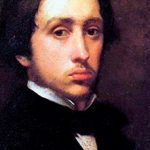
Mary Cassatt
Mary Cassatt is considered the painter of mothers and children. She was an American artist, who lived between 1844 and 1926. Mary’s mother was an educated woman, she believed that traveling allowed people to have another vision of life. That is why Cassatt traveled for 5 years with her family and lived in some capitals of Europe.

Cassatt showed an interest in art and decided to start studying in her hometown of Pittsburgh. Although her father did not want an artistic career for his daughter. She did her studies at the Pennsylvania Academy of Fine Arts at the age of 15. Twenty percent of the institute’s students were women, but most were there to learn art as a social skill, not to pursue it as a career.
Mary soon realized that this institute was not enough to learn what she wanted. The female students could not use models, unlike their male peers. Besides, teachers patronize women, this upsets the artist. The learning was slow and tedious. At 22, Cassatt decides to move to Europe, her mother supports and accompanies her. In 1866, when they arrived in Paris, women could not study at the École des Beaux-Arts, so Cassatt requested private lessons.

In addition to private lessons, Cassatt used to go to the Louvre to copy paintings, thus learning on her own. It was a practice that many artists and copyists used to do. The Louvre also served to socialize and meet other artists in training.
In The Box. Mary Cassatt. 1879.
Unexpected Return to North America
In 1870 the Franco-Prussian War broke out and Cassatt had to return to the United States. This was a setback for the artist. When she returns, she continues to paint but realizes that there were not many paintings to learn, making it difficult to continue her learning. Also, there were no buyers for her art. Felt her life and her career stagnate. America was not the ideal place to develop. She thought that if she did not return to Europe her career would end.
The war ended in 1871 and Mary can return to Europe. She decides to go to Spain and Italy before returning to Paris.
The Impressionists
Upon returning to Paris, Mary opens a studio. She has a wider audience and is more recognized. However, as the years went by, she became frustrated that the artists were not experimenting more. They always stuck to historical themes, classical style. Waiting for a jury to present artwork. A need for evolution, for change, begins to emerge in her.
Then, in 1877 the artist Edgar Degas invited her to the group The Impressionists. Later they would be close friends. They felt very comfortable together, as they both similarly saw the world. Degas suggested to Cassatt that she always carry a notebook to take notes and drawings of what she was seeing, and also that she concentrate on the portraits.

The Impressionists were a group of young painters who liked to experiment with color and light. They painted day-to-day subjects, about nature, leaving aside the classic style. Cassatt accepts Degas’s proposal to join the group. This would be the most productive period for Mary Cassatt, also the most recognized one.
Little Girl in a Blue Armchair. Mary Cassatt. 1878
Her Artwork
Most of Mary Cassatt’s artwork turns around children and mothers. Despite not having married or having children, these were the themes that she developed the most. Mary Cassatt had many nephews and her relationship with her mother was always harmonious.

Cassatt’s artworks are full of light and joy. Her period in the Impressionists was the most productive. Over time, she began to move away from the group and began to experiment on her own. She was inspired by Japanese art, the use of black begins to be noticed in her artwork. Black was a disapproved in Impressionism.
Young Mother Sewing. Mary Cassatt. 1900.
The Pioneer
Mary Cassatt was a true pioneer in art. She dared to take her passion for art a step further, to seek new horizons, to experiment.
In 1868, the Paris Salon jury accepted for the first time artwork by Mary Cassatt, A Mandoline Player. That year, Cassatt along with another American, Elizabeth Jane Gardner, is the first American woman to be accepted at the Paris Salon. She exhibited again for the Paris Salon in 1872, with the work Two Women Throwing Flowers During Carnival.

Mary Cassatt was one of the first artists to bring largely original art to America. From time to time she would travel to her country, in doing so she brings artworks by other artists, to be exhibited by museums. In this way, American art students would not have to travel to Europe to study them.
Mary Cassatt supported the fight for women’s rights, encouraged and inspired young women to study art. Some people considered her an ¨American treasure¨. In 1904, France awarded her the Chevalier de la Légion d’honneur, for her contribution to art.
A Mandoline Player. Mary Cassatt. 1872.
Sources:
https://www.youtube.com/watch?v=EzElAusnaAs&t=177s
https://es.wikipedia.org/wiki/Mary_Cassatt
https://elpais.com/cultura/2018/03/27/actualidad/1522151403_837829.html