Judith
Holofernes, the symbol of evil, presses on the tribes that do not obey King Nebuchadnezzar. According to the story, while the other tribes surrender, the Israelites resist. In the city surrounded by the army of Holofernes, the children were dying of thirst. Rumours of surrender begin to spread. Thus begins Judith’s story. Religious Judith, who lives with her deceased husband’s inheritance and a maidservant, plans to save her people. She explains her purpose to the elders of the city but keeps details secret.
Despite the opposition of the elders, Judith has made her decision. She gets up early in the morning, takes a bath, puts on perfume, her most elegant clothes, precious jewels and pretends to escape from the city with her maid Abra to take refuge in the general’s camp. She approaches the general as if she were going to explain how to easily take the city down. Thus, he will conquer the castle from within. Seeing Judith’s beauty, it does not occur to him to question or act cautiously. And the famous scene of the art world approaches… One night, drunk Holofernes is beheaded with the sword of Judith whom he took to his tent.
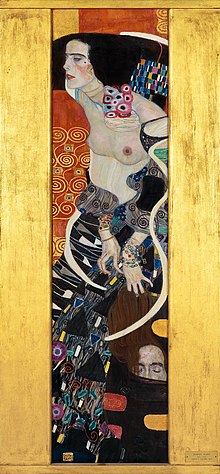
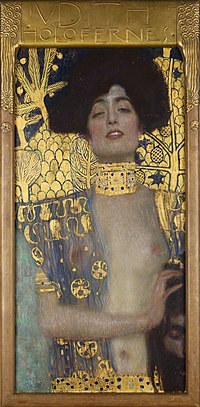
Here is Gustav Klimt’s version of Judith above. We can see the intoxication of the harmony of lust and pride on her face. She is half-naked bringing the mind that she was seducing Holofernes a scene ago. Klimt also made a second version of the painting, here it is also.
And here is Artemisia Gentileschi’s Judith.

According to my opinion, seeing Judith and Abra’s struggle makes the painting more real. It allows the viewer to include in the painting. Artemisia Gentileschi makes us live that violence, empathize with Judith and feel all that disgust with blood everywhere coming from a living, moving creature.
Seeing Gentileschi’s version and realising what Judith actually might have been felt makes us understand Klimt’s version deeper, I think. There is a woman who has just lived kind of an intimidating moment with someone she knew she was supposed to kill. Even though it was for her people, her tribe, she killed someone. She killed someone she has talked to. It’s really visible how powerful she is in Gentileschi’s painting although elders didn’t want a woman -who is a widow- to do something like this in the story.
She knows what exactly she has to do even though she is struggling and disgusted. In a moment of ‘living’ this scene, the relief of Klimt’s version’s expression became more and more accurate. Imagine achieving something people told you cannot do. Remember how it feels? Okay, now, imagine this achievement is saving your tribe! All that violence, pride, maybe a little arrogance after that… THIS has to be the perfect representation of Judith’s mind.

I’d like to add Caravaggio’s version of Judith as well. His Judith is pure unlike the other ones, looks a little scared yet decisive and repulsed.
Jezebel
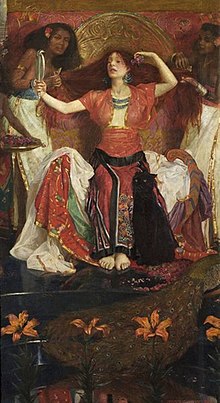
In the Book of Kings, Jezebel is introduced as the Phoenician princess and daughter of Etbaal I, king of Tyre. Jezebel married King Ahab of Samaria, the northern kingdom of Israel.
This marriage culminated in the close relations between Israel and Phoenicia during Omri’s reign and likely solidified Ahab’s political power. Like Solomon’s foreign wives, Jezebel maintained her way of belief and worship, so Ahab built an altar in the temple of Baal in Samaria.
Jezebel is known as one of the greatest sinners and a killer. She refused to believe Elohim and remained Pagan. Just like Kalmah’s song ‘’Kill the Idealist’’, Jehu killed Jezebel’s children and throw Jezebel from the window. After killing Jezebel, he gave a feast to celebrate it. Only remembered to check and bury her body afterwards to find out she was eaten by dogs. Jehu killed nearly the whole lineage of Ahab.
Jezebel’s name meant ‘’God is my oath’’, which I like to think of as ‘’I will make my god what is my oath’’ She was faithful, strong and good at politics. However, she was also mentioned as a false prophet… I don’t believe that there is much to say about her. Some people may think that she idealistically died for her beliefs meanwhile some think that her death was obligatory. She is a powerful symbol both for feminists and religious people’s, in very different ways.

Hypatia
Hypatia, the daughter of a famous mathematician of the period; was interested in philosophy, mathematics and astronomy. Alexandria, where she lived, was famous for its library, philosophy school, museum, and most importantly for its eclectic environment. Unfortunately, the only remaining texts from Hypatia is some of the letters between her and Synesius. According to the surviving 5th-century sources which describe Hypatia as the teacher of the philosophies of Plato, Aristotle and Plotinus.
Since she was a Pagan, bishop of Alexandria, Cyril was strongly against her. Orestes, the Alexandrian governor, one of many students of Hypatia, supported her thoughts and actions on the other and. Consequently, political problems arose between him and Cyril. Her cause of this conflict led a Coptic Christian group to kill her along with Cyril’s words.
The issue turned into a city-wide provocation while Bishop Cyril’s accusations increase and increase. “Women must learn silence and meekness. I will not allow a woman to teach nor to have authority over a man. You will be silent, and you will remain silent; Because Adam was created before Eve,” Cyril said. He supported the speech with biblical quotations and provoked the public. Thus, Hypatia was clearly declared “profane” and “evil” among Christians. One morning, when Hypatia was leaving her house, dozens of people who had been provoked got her out of her car. Then, she was dragged by the hair, taken to the church. Provocateurs brutally killed and burned her in the church in the end.
After Hypatia’s death, the Platonic school disappeared with her too. Hypatia was a favourite of the 18th-century Enlightenment. The rationalist, agnostic Voltaire portrayed her as a victim of superstition and ignorance. ‘’Her murder is the symbol of the extinction of intellectual freedom along with Greek Gods,’’ Voltaire said.
Hypatia also can be seen in Raphael’s “School of Athens” painting. Although Raphael thought that Hypatia was the most valuable student of the Athens School, he said that it was not Hypatia that he drew in response to the pressures he was subjected to, but the bishop’s niece.

She is credited with these works according to Wikipedia.
A commentary on Diophantus’s thirteen-volume Arithmetica, which may survive in part, having been interpolated into Diophantus’s original text
Another commentary on Ptolemy’s Almagest treatise on conic sections, which has not survived
Many modern scholars also believe that Hypatia may have edited the surviving text of Ptolemy’s Almagest, based on the title of her father Theon’s commentary on Book III of the Almagest

Jeanne d’Arc
While the Hundred Years War was raging and the Britannia was about to take over France, a girl named Jeanne who was born in the village of Domremy in the Meuse in 1412, began to say that God had sent her to save her country when she was just twelve years old. As time went on, the girl whose visual and auditory experiences increase, believed wholeheartedly that the true ruler of the country should be crowned in Rheims cathedral, and she believed that it was her divine duty to do so.

Even though every member of the village found what Jeanne was saying crazy and tried to dissuade her, she went to the castle of Robert de Badricourt, who ruled their region, with such great fate and asked him to appoint someone to accompany her. Badricourt initially taunted and refused her, but finally, he was unable to resist her insistence and gave her six men. Jeanne dressed as a man to go to Chion in 1429 with the soldiers next to her. There she succeeded in gaining the king’s trust and was subject to the scrutiny of the clergy. If she received a positive response, an army would be placed under her command according to the deal. She was accepted without any problem and went to the city of Orleans with an army of four thousand men. Seeing the soldiers’ despair, she encouraged them by speaking of the divine destiny she believed in full-heartedly. They achieved great successes in a short time. Jeanne was always on the front lines, which gave her soldiers confidence and faith. Even when the castle of Tourelles, which seemed impossible to take down, was besieged, she was one of the first ones to enter the castle. She and her soldiers managed to take the castle down.

After this event, the British suffered defeat after defeat and became discouraged. Now the hope was with the French soldiers. Jeanne was welcomed with great enthusiasm at Lyons. She felt that she had finally done her duty, so she took the king to Rheims so that he could complete his coronation in accordance with Christian tradition. Then she bowed before the king and said, “Now the will of the god has been done. I, following his orders and wishes, liberated Orleans from the enemy and secured your coronation. God has shown that you are the true king. All of France is yours now!” she shouted.
Jeanne had achieved her goal, but she couldn’t stand the fact that Paris was still in enemy hands. She asked the king’s permission to fight for the last time in Paris. Fearing to anger the duke of Burgondy, but also knowing that he could not dissuade the young girl no matter what he did, the king gave her an army that wasn’t really sufficient at all and caused her to fail. To please her on the return, Jeanne and her family were conferred nobility and exempted her village from taxes… But Jeanne’s mind was on the battlefield.

One day, she learned that the duke of Burgondy, who was in league with the British, was heading towards Compiegne, and she jumped on her horse with the desire to help her people there. She was captured by the Luxembourg ducal as soon as she left the city. After that; Father Cauchon, who was on the side of the British, wanted to try her in the inquisition with the desire for revenge. However, since Cauchon did not want her to be remembered as a saviour, he said that it was the work of the devil to say that she had heard from God, that it was a sin against the church to claim that she spoke to God without the intermediary of the church and that dressing like a man insulted her gender.
The Father had the young girl tried for witchcraft and eventually, she had to sign a document pleading guilty to all charges. She was rumoured to be singing songs while she was burning alive in the Rouen area on May 30, 1431. Twenty-five years after her death, Jeanne d’Arc was declared a saint by the decision of the re-established court and later she became the symbol of France by Napoleon’s will.
Tomris
The Sakas were a highly modernized tribe, living in the agricultural basin of northeast Eurasia, with a highly developed ability to breed horses and mining. The word Saka started to be used in Old Persian after the Achaemenid period. They are thought to be closely related to the Scythians; in this context, it has been suggested many times that they were Scythians. Sakas is thought to be a Turkish tribe with Persian roots. And although one of the most important weapons of the Saka people was an axe, they gave great importance to archery.
Tomris, who lived in the sixth century, was in a great war with the Achaemenid Empire, which ruled at the same period. There are many theories about the name of Tomris. One of them is that it could be “Temir” (Demir) -iron- in Turkish. Besides, “Tahmirih” in Eastern Iranian languages -which means brave- could be either. She is thought to be the nephew of Alp Er Tunga, the main character of a Turkish heroic epic which is mentioned as a Saka Khan in the text.
With the death of her husband Alp Khan, Tomris became the head of the state. Meanwhile; the King of Persia, Cyrus, put an end to the New Babylonian Kingdom at that time and took Mesopotamia under his rule. Since Cyrus conquered Babylon, he started to go on expeditions on Sakas. Even though Tomris was following a moderate policy that did not want to go to war, Persian attacks on Saka land did not come to an end. Tomris responded to these raids by setting the fields on fire, poisoning the water wells and retreating from the area. She thought it would be best for the welfare of the people to stay away from the war in this way.
The war which its most detailed sources belong to Greek Historian Herodot was growing day by day. When Cyrus realized that he wouldn’t get the battle he wanted, he decided to propose to Tomris and said that he would leave the Sakas if she married him. Knowing that Kiros cannot be trusted, Tomris Hatun rejected the offer. Upon this, Cyrus, enraged, moved towards Saka lands with a huge army. Convinced that it would be better to fight instead of a policy of retreat, Tomris responded with everything she had.
Cyrus, wanting to set a trap, had an entertainment tent organized between the two armies. So, when Tomris’ son Spargapises defeated a Persian force, he tasted victory and went to the tent with his soldiers. When they got drunk, Cyrus was ready to kidnap him…
When Spargapises sobered up, he was a prisoner. Cyrus declared that he would set Spargapises free, no harm would come to him and he would only be used to threaten his mother. Because his responsibility towards his people and his pride did not allow this, he committed suicide after asking for his hands to be set free. Thus, there was no trump card to be used against his people.

Herodotus noted that Tomris had sworn to satiate Cyrus with blood when she learned that the troop and his son had died. Despite this, Tomris sent an emissary to Cyrus, telling him that he didn’t win with courage but with treachery. She wanted her son’s body back and said that if he left the Saka borders as soon as possible, his life would be spared altho his atrocities.
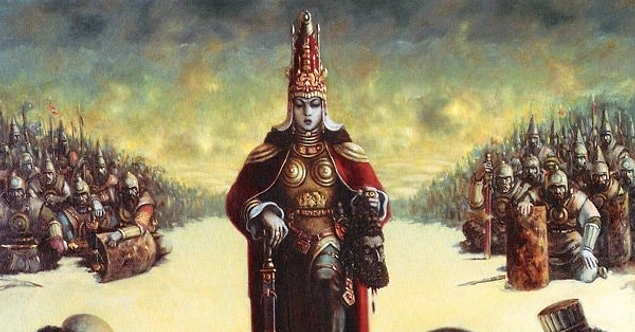
Although there were well-trained warrior dogs in the Persian army, the skilful archers of the Sakas and their strong war strategy (according to the sources, the pincer movement was used in this war) won them this war. At the end of it, Tomris found the body of Cyrus walking on the battlefield and dipped his cut head into a barrel full of blood and carried it around the battlefield. It is also recorded that Tomris said, “You couldn’t satisfy your bloodthirst when you were alive, now I’m going to sate you to it!”

Thus, Tomris defeated a majestic army and went down in history as a strong leader. Although frames from her magnificent story have been reflected in art history by many European painters, the woman we see in these paintings does not fit ‘’Tomris’’ in history. Not only because of the inaccuracy of her ethnicity, but the image of the queen in the gaudy dress we see in Rubens’ painting, for example, is inaccurate. Yet this is what we have…


Salome
After his father’s death, Herod Antipas officially became the ruler of Galilee and Perea as a client state of the Roman Empire. Herodias was married to Herod ll, however, she divorced herself from him and married his brother. Salome was the daughter of Herodias from her first marriage. John the Baptist cursed the marriage between Herod Antipas and Herodias since she was married to Herod Antipas’ brother before. He claimed that this marriage is illegal according to the law of God. In conclusion, Herod imprisoned the Baptist. However, he didn’t want to kill him since he was a venerable cleric. His wife, on the other hand, was pretty upset about him cursing her marriage. She had a grudge against him and seek to take revenge.
She met the fortune that was hoped by her. Her husband Herod Antipas throw a huge birthday party for himself. There, Salome danced like no one danced before. She was the representation of lust, desire and sin. Every single one of the guests was mesmerized by her fascinating dance. Thus; the king granted her a wish, saying it could be anything. He would have given even half the country if he wanted to.
Here comes the conflict. In the original story, Salome goes to her mother to ask what should she wish for. And her mother requests her to wish for John the Baptist’s head. But Salome is a sinful human being, isn’t she? She is a total femme fatale. Well, some people think otherwise. Since the hateful one who manipulates her daughter was Herodias, Salome could be innocent. She asked for John the Baptist’s head and the king couldn’t return from his promise so he had to accomplish it.
According to Flaubert’s Herodias, Salome is the victim. She neither knows who is John the Baptist when she asks for his head nor when the head is brought on a tray. She is just an abused child. She is portrayed this way in the biblical version of the story too. Yet we move toward Joris-Karl Huysmans novel À rebours, Salome we see became different.

‘’In Gustave Moreau’s work, conceived independently of the Testament themes, Des Esseintes as last saw realized the superhuman and exotic Salome of his dreams. She was no longer the mere performer who wrests a cry of desire and of passion from an old man by a perverted twisting of her loins; who destroys the energy and breaks the will of a king by trembling breasts and quivering belly. She became, in a sense, the symbolic deity of indestructible lust, the goddess of immortal Hysteria, of accursed Beauty, distinguished from all others by the catalepsy which stiffens her flesh and hardens her muscles; the monstrous Beast, indifferent, irresponsible, insensible, baneful, like the Helen of antiquity, fatal to all who approach her, all who behold her, all whom she touches.
Thus understood, she was associated with the theogonies of the Far East. She no longer sprang from biblical traditions, could no longer even be assimilated with the living image of Babylon, the royal Prostitute of the Apocalypse, garbed like her in jewels and purple, and painted like her; for she was not hurled by a fatidical power, by a supreme force, into the alluring vileness of debauchery.’’
Gotta add, Oscar Wilde, who was influenced by Huysmans, wrote a tragedy about Salome. In the play, Salome was placed as that great femme fatale. There, Salome was in love with John the Baptist. However, he rejects him by insulting her because of her mother’s marriage. When she realizes that no matter what she does, she can’t get what she wants, she went mad and went to her stepfather. Since he said that if she dances, he will give her anything, she agreed.
She started to dance with seven veils and threw every one of them one by one until she is naked. When it’s time for her reward, she asked for John the Baptist’s head. The king tried to make her give up offering everything he had but she didn’t hesitate. In the end, they brought the head and this monologue occurs:
‘’Ah! j’ai baisé ta bouche, Iokanaan, j’ai baisé ta bouche. Il y avait une âcre saveur sur tes lèvres. Était-ce la saveur du sang? … Mais, peut-être est-ce la saveur de l’amour. On dit que l’amour a une âcre saveur … Mais, qu’importe? Qu’importe? J’ai baisé ta bouche, Iokanaan, j’ai baisé ta bouche.’’
(Ah! I have kissed thy mouth, Jokanaan, I have kissed thy mouth. There was a bitter taste on thy lips. Was it the taste of blood? … But perchance it is the taste of love. … They say that love hath a bitter taste. … But what of that? what of that? I have kissed thy mouth, Jokanaan.)

Plus:

Halide Edib Adıvar
Halide Edib is a Turkish war hero. She encouraged people that they could win. She took part in the war as a civilian with Mustafa Kemal Atatürk, saviour of the country. And she became a corporal. She was one of the most prolific writers of her time and she also played a big role in Anatolian Agency’s founding. She worked as a journalist to inform the country at that time… Here is a portrait of her by Alphonse Mucha…