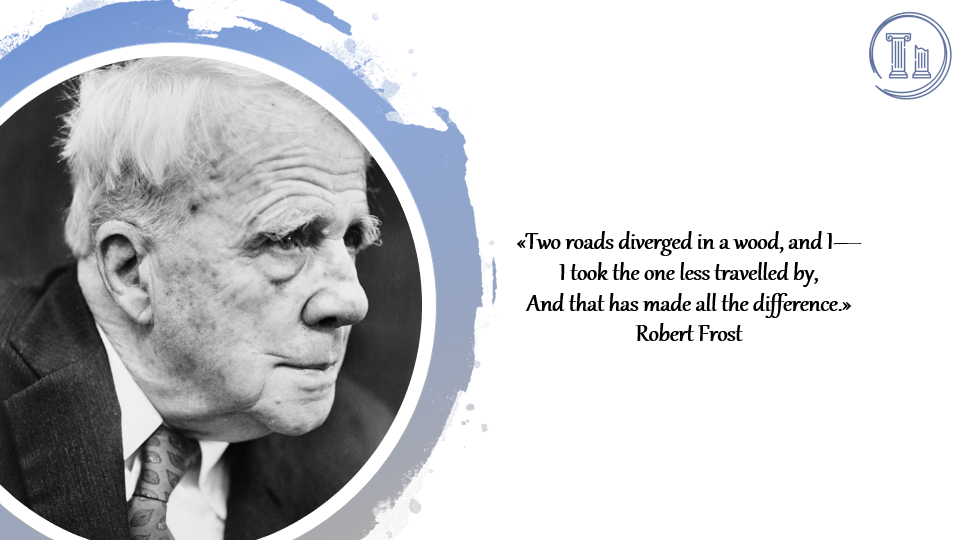
A Brief Information About Him

Robert Frost, born on March 26, 1874, and died on January 29, 1963, was an American poet. Frost got four Pulitzer Prizes for Poetry and also was honored with Congressional Gold Medal during his lifetime. Additionally, his works mainly mirrored complex society and gave philosophical volume to the reader. Therefore, today we are going to discuss his most famous poem, “The Road Not Taken,” according to existential and ironical view.
How does irony and its philosophical meaning function in Robert Frost’s “The Road Not Taken”?

The famous poem of the American poet Robert Frost called “The Road Not Taken ” has been widely discussed and interpreted by literary lovers and critics in the past century and, of course, in the current period.
Two roads diverged in a yellow wood,And sorry I could not travel bothAnd be one traveler, long I stoodAnd looked down one as far as I couldTo where it bent in the undergrowth;Then took the other, as just as fair,And having perhaps the better claim,Because it was grassy and wanted wear;Though as for that the passing thereHad worn them really about the same,
The irony, the literary device, portrays the contrast between appearance and reality. In The Road Not Taken, written by Robert Frost, the speaker comes across two different roads. In appearance, these seem like “roads,” but “roads” imply choices in reality. Thus, the poem allows the reader to think about choices in life. It is all about the choices one makes in life. Think about you and your choices in life. Have you ever said, “I wish I would not have done this” before? This is the window that lets you see the balance of your choices.
And both that morning equally layIn leaves no step had trodden black.Oh, I kept the first for another day!Yet knowing how way leads on to way,I doubted if I should ever come back.I shall be telling this with a sighSomewhere ages and ages hence:Two roads diverged in a wood, and I—I took the one less traveled by,And that has made all the difference.
In the conclusion of poem, the speaker takes the one less travelled by and that has made all the difference. The speaker wonders about the other path he does not go, he wants to go back and take the other road but he doubts whether he ever will. Heraclitus says “You could not step twice into the same rivers.” If he had gone back to the beginning, neither the road nor he would be the same.
A question: is it just what human being chooses or is it just what human being does not choose?
This reminds of the quote of Dostoyevsky “No matter what you do, you will die in regret, maybe because of what they did, maybe what they didn’t.” Every decision is a choice, and every choice is a decision. If someone traveling on the bus is sitting on the right, he does not see what is happening in life on the left; if he is sitting on the left, he cannot see what is happening in life on the right.
You can listen two different voiced and animated videos of the poem:
If you have interest in Pablo Neruda just click here A Spanish Revolutionist A World Ambassador Neruda
Follow us on Twitter: MozartCultures U.S. (@MozartculturesU) / Twitter
Follow us on Instagram: MozartCultures US (@mozartculturesus)