Origin
The first appearance of the term “rinascita”, which means rebirth, comes from the fundamental source of information on Italian art “Lives of the Artists”(c.1550) by Giorgio Vasari, who is known as the father of art history. The term anglicized as Renaissance in the 1830s. The term Renaissance has French origin, and was used for the first time by Jules Michelet, a famous French historian.
In European history, the Renaissance is defined as a cultural movement that includes art, architecture, philosophy, literature, music, science, and technology. Beginning in Italy, it spread across all of Europe in the 16th century. The Renaissance is seen as a transition era from the Middle Ages to contemporary times. It contains aspirations for classical ideals in art, and a continuation of humanism that an intellectual movement began in the 14th century in Northern Italy. Distinctive characteristics of fine arts in the Renaissance are; order, ratio, symmetry, perspective. Its subject matter is mostly religious, mythological, and historical, and portraits of individuals. In the Renaissance era, Gothic architecture and its techniques were abandoned, yet the influence of Roman and Greek ruins is seen.
Urbino

In the Renaissance era, Urbino is a little city-state in Italy. The city is situated on a steep slope, and the town retains much of its picturesque medieval look. Under the patronage of Federico da Montefeltro Condottieri (Duke) of Urbino from 1444 to 1482, an extraordinary historical heritage of independent Renaissance culture was formed.  Federico da Montefeltro was a successful commander of mercenary. He rebuilt the city according to modern conception, by creating the elegant Palazzo Ducale in the centre of Urbino. He manifests himself as a worldly man. Known as a humanist, intellectual, and a great fighter, he works with artists as well as architects – such as Piero Della Francesca.
Federico da Montefeltro and his versatility was portrayed in “The Portrait of Federico da Montefeltro and His Son Guidobaldo”, dating from c.1475. The portrait symbolizes both his humanist and military sides. His studio is surrounded by symbols of his power and interests. In the painting, Montefeltro sits on a chair, and reads from a codex. Codex were expensive items at the time, and a nod to his humanistic desires. Guidobaldo, Federico’s younger son, who also wears fancy clothes and occupies a command post, is next to Federico, the future Duke of Urbino.
Florence

Florence (Firenze, in Italian) is a city where the Renaissance was born. The establishment of the city of Florence is around 59 BC with the name of Florentia. Most of the buildings were built during the Renaissance, and almost all of them survive until today. In the first half of the 15th century, the city was under the domination of the Medici family. In time, they became more and more influential and richer thanks to their banker profession.
Cosimo, the most important family member of the Medici family, built a large palace called Palazzo Medici. Later generations of the Medici family continued to build magnificent buildings as well. 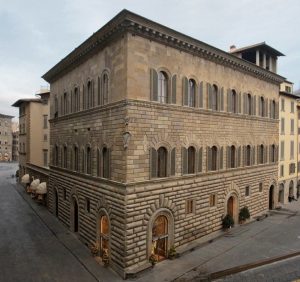 They gave great importance to art and architecture. Sponsoring a number of famous artists financially such as Donatello, Michelangelo, Leonardo da Vinci, and Botticelli. Many of the great artists of the Renaissance worked for the Medici family. The Medici’s had a crucial role in the beginning Renaissance era in Florence. Florence became a centre for new artistic forms, under the auspices of them and other wealthy citizens. Their sponsorship helped to increase the city’s prestige in terms of pioneering art and architecture.


Artistic nuances
The important figures in Florence are countless. “The Allegory of Spring”, c.1480, and “The Birth of Venus”, c.1484-1486 by Botticelli are some of those. These paintings are the most famous and iconic ones in the Renaissance era. In the paintings, Botticelli used a huge size of a nude female figure that was unprecedented in Western art since classical antiquity. Botticelli also used numerous flowers (which are still found in Florence’s flora), in the painting of “The Allegory of Spring”. Although, the painting is not very clear, so it may be difficult to see them. These nuances highlight the uniqueness of his art and the beauty of its details. 
Another outstanding figure in the city is “Dome of the Florence Cathedral” by Brunelleschi. It is also known as “Santa Maria del Fiore” , built in 1296-1436. The building was designed with late-Gothic aspects, and evokes the Romanesque style with its coloured marble façade cladding. In contrast, simplicity and clarity can be seen in its interior, which is associated with the Renaissance era. The dome’s bright lighthouse on the top, is not only one of the most significant elements that determine the silhouette of Florence, but also the first example of similar domes that are an integral part of all Renaissance cities.
References
https://www.wikiwand.com/en/Renaissance
https://www.wikiwand.com/en/Urbino
https://www.wikiwand.com/en/Portrait_of_Federico_da_Montefeltro_with_His_Son_Guidobaldo
https://www.wikiwand.com/en/History_of_Florence