Reality is an experience. It is defined by the measurable, calculable, or perceivable factors that are mutually experienced with a common ground of validity. Yet, it is an individual concept as the subject of the experience is the person. Even though there are specific points about what the category of “real” encompasses, many of us have found ourselves questioning the reality of our emotions, beliefs, thoughts, and dreams. It is hard to tell, as the sensations of being in such atmospheres prove to us that they are real until we step foot in a different perspective. By analyzing the perceived dynamics of these changing mental states, we build a general idea and a common ground about reality. Classifying these experiences accordingly to what we know to be true determines how we perceive and make sense of them. Even though there are stable points that make up our common acceptance of what “real” is, the definitions in our minds are prone to change with cognition. Would that make reality an idea, intuition, sensation, or perception? Maybe we wouldn’t quite state it like that, as the edges of the topic have been defined too sharply until recently. Luckily, not anymore.
See also : ART OF US: The Collaboration of Human Vision and Artificial Intelligence
Even though the introduction of the term Virtual Reality goes back to the 1980s, a lot took place since then, and many more terminologies entered the dictionaries. With the improvement of different forms of environments, XR became an umbrella term for Extended Reality; involving all real, virtual, or combined environments which are VR(Virtual Reality), MR(Mixed Reality), and AR(Augmented Reality). These 3 concepts are separate in terms of how deep the environment is experienced. AR stands for the concept of a combined environment where users’ encounter with the real world is diversified by virtual extensions. Imagine going to a pool and seeing the temperature of the water as a hologram on top of the pool. There you have virtual elements while you are still experiencing the actual reality as a basis. AR fundamentally carries the same configuration as MR, as means of building imaginative reality on top of the actual one with a slight difference owing to MR having the functionality to manipulate the experience a little further. Like the pool’s blue color can be purple or black and silver fish might be swimming in it. On the other hand, VR sets up the illusion of a real environment with a fully simulated atmosphere aiming for the users to feel completely present.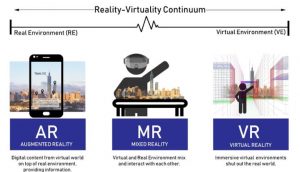
The elements that are taken into consideration while designing an XR experience, are based on the analysis of how we perceive reality. Think about how the human brain perceives depth. Our brains create an estimation of depth from the 2D visual input that comes separately from each retina and piecing the two slightly different images together, forms the perception of depth. A concept whose introduction and analysis led to the invention of stereoscopes which function the same way our brain does while creating an illusion of 3D vision. The same technique is also used in VR glasses as depth perception plays a huge role in creating realistic virtual environments; to give a sense of presence thus setting up the believability of the experience. The illusion of presence depends highly on how the setting is designed, how much the senses are stimulated, and whether the user receives the expected reflections in the ambient. For instance, you might expect to see bamboo that is planted in the clouds in golden skies while having a VR experience. If it is designed with such an atmosphere to make you believe that you have just entered a new world, it is believable. Details like the wind blowing your hair while you’re reaching up to the clouds, seeing the reflection of the light on the plants or anything that will allow you to observe the expected phenomena with the stimulation of senses will deepen your presence. However, you would expect to see certain modifications on top of real-life elements while having an AR experience. That is why exaggerated modifications to the setting might detach you from feeling present in the environment.
The adjustment of all of these elements makes up a field with the door wide open for creativity: A garden full of whole new worlds of various realities. All are being built from intelligence which constantly seeks to sail further from what it has discovered, following a curious pattern that has been with us since the beginning of evolution which led to the establishment of civilization and technology. Something that connects itself to the most complex systems just by being the most basic principle of life: Survival. To transfer its code by leaving a mark on the infinity of existence is the instinctual drive of humanity. The way we perceive and understand life evolves with us, allowing us to reproduce, model, imitate, and create natural mechanics in many fields; shaping our imagination to the extent of being able to design reality through algorithms.
REFERENCES
https://www.sciencedirect.com/topics/neuroscience/stereopsis
https://bigthink.com/the-future/vr-ar-mr-xr-metaverse/
https://www.uxmatters.com/mt/archives/2018/06/xr-design-imagination-immersion-and-presence.php