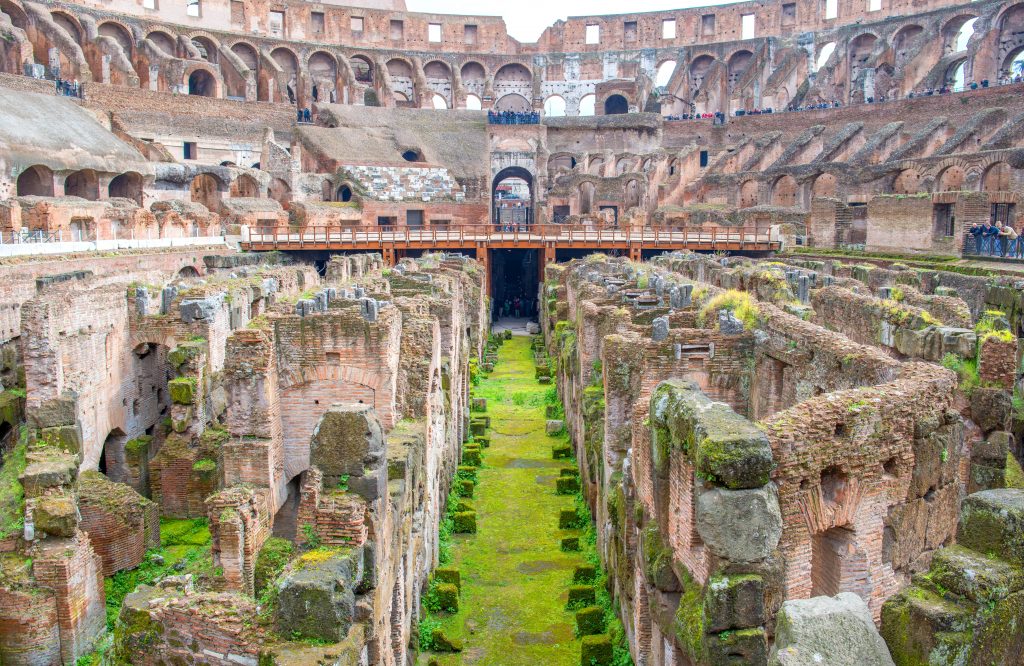
The Colosseum, as one of the most magnificent structures from ancient history, was built between 70/72 CE under the heel of Vespasian and was finished under Titus, his son in 80/81 CE. The Colosseum is the first example of an amphitheatre in the ancient world. Amphitheatre comes from Greek words ἀμφί (amphí, “on both sides”) and θέᾱτρον (théātron, “theatre”). It is basically two théātron compounded.
The name Colosseum, on the other hand, comes from the Latin word colossus (huge). This name, however, was never used in antiquity but was rather given after the era. It is assumed that this structure was called Amphitheatrum Flavium (The Flavian Theatre) at the time, but this is also not certain.

The structure was placed among the three hills of Rome, namely Mons Palatinus (Palatine Hill), Mons Esquilinus (Esquiline Hill), and Mons Cælius (Caelian Hill) to create an illusion as if the structure dominates over the city. Placing the structure in the center of the city was an intentional decision. The long, tiresome civil wars during the republican era had caused Rome to lose its awe. We know that Vespasian wished to revive the city’s glory since he had several coins minted with the inscription of Roma Resurgens (The Reviving Rome).

The columns of the structure are mixed with Greek architecture styles. On the first layer, the columns are in the style of Doric (Δωρικός), the second, Ionian (Ἴων) and the third, Corinthian (κορινθιακός). It has at least 80 entrances, and 76 of them were numbered. Two of the entrances were for the gladiators. Gladiators who lost the fight would be killed and dragged through the western port called Porta Libitinensis (The Gate of Death) while the victors would exit through the eastern port called Porta Triumphalis (The Gate of Triumph). Occasionally, gladiators who lost the fight would be pardoned, and these gladiators would use the Porta Triumphalis. The Porta Triumphalis was also the gate where the gladiators would enter the arena. Although these ports were referred to as such, it is controversial since the only succeeded written sources today are from the late antiquity, which includes an anonymous work of a biography about Commodus; and a diary by St. Perpetua, a noblewoman, who had written during her captivity and later was executed in the arena due to her faith in Christianity.

The capacity of the Colosseum could hold circa 50000 spectators -45000 seated and 5000 standing- at maximum. A huge marquee would have been used to prevent the heat or rain. The arena (Lat. harena, meaning sand) was surrounded by a podium, and the spectators would sit on marble seats. These seats were numbered and separated to distinguish the spectators -the rich citizens, the plebeians, and the noncitizens. Women would sit on the wooden seats, and there was a section for the slaves where they would stand and watch the games. The emperor and his family would sit in the lodge.

A bronze sestertius minted c. 80/81 CE as a commemoration. On the obverse, a depiction of the Colosseum engraved with the details of the podium and sections of the seats, and in the middle, a larger dot depicted the emperor himself. On the reverse, Emperor Titus seated on the sella curulis, holding a scroll and an olive branch as symbols referring to him as the legislator and peace-maker. Around him, a pile of arms refers to the wars he triumphed over the enemies. The inscription on the coin;
Transliteration:
- IMP•T•CÆS•VESP•AVG•P•M•TR•P•P•P•COS•VIII•S•C
Transcription:
- IMP(erator) T(itus) CÆS(ar) VESP(asianus) AVG(ustus) P(ontifex) M(aximus) TR(ibunicia) P(otestate) P(ater) P(atriae) CO(n)S(ul) VIII S(enatus) C(onsultus)
Translation:
- Emperor Titus Caesar Vespasian Augustus, (as) the chief high priest of the College Pontiffs, given the tribunician power, (as) the father of the land, (during) his 8th consular ship, (had this coin minted) by the decree of the Senate. (The transliteration, transcription and translation belong to the respective author)
While the gladiator fights were the most popular ones, there were various games like chariot races, exotic animals, processions, counterfeit naval battles, and in further years, executions were demonstrated of convicts, traitors, but the majority were the Christians.
Among the games, it has been always assumed that the most spectacular event was probably the mock naval battles, although there was no written evidence of it. This event was referred to as Naumachia (ναυμαχία) in the ancient texts, and these staged battles actually took place in Roman history. Based on ancient texts, the first naumachia was given by Julius Caesar in 46 BCE, over a hundred years before the Colosseum existed. Near the Tiber, Caesar had a basin dug for enough water to hold the actual naval ships. The prisoners of wars would be used for this entertainment as rowers and combatants. When the Roman Republic came to an end, and the Principatus began, many emperors would execute naumachia in various venues. It is assumed that the Colosseum was among these venues. If the Colosseum was used for such a game, it leads to the problem of the scale of the warships since the arena would be too small for such warships as biremes, triremes and quinqueremes to manoeuvre. Thus, it has been suggested that the smaller scale of these ships were reconstructed only for this game.

All the demonstrations held in the Colosseum had atrocity in common. The games could be so atrocious, wild animals would unexpectedly enter the arena in the middle of a gladiator fight. Domitian, Vespasian’s younger son, constructed the hypogeum a series of tunnels and cages under the ground, where the captives and wild animals would be held. He took the level of atrocity even further and used the executions as parts of the games, and during the executions, he would give the order of releasing the wild animals while the captives, unaware of the situation, would be held in the arena. Countless lives had seen a brutal end and this had continued for hundreds of years which eventually overshadowed the dignity of Roma Resurgens.

In 217 CE, the Colosseum was damaged by a major fire (or lightning according to Cassius Dio). In the 5th century, a major earthquake caused damage to the structure. The Colosseum was repaired and restored from time to time according to the written records. Within years, due to the decreasing economical state of the empire, the popularity of the games lessened and the Colosseum was left to be decayed. For a long time, this colossal structure held nothing but growing weeds. Today, it has become a popular tourist destination, visited by tourists from all around the world. Moreover, in 2001, it was added to the list of the New Seven Wonders. Despite its bloody history, the Colosseum will remain as a spectacular architectural piece left to the world by the Romans.


REFERENCES
Cassius, D. (n.d.). Roman History. May 21, 2021, from https://penelope.uchicago.edu/Thayer/E/Roman/Texts/Cassius_Dio/home.html
Claridge, A. (1998). “Rome: An Oxford Archaeological Guide”. Oxford, UK: Oxford University Press.
Hopkins, K., Beard, M. (2005). “The Colosseum”. Cambridge, MA: Harvard University Press.
Martialis. (n.d.). Liber de Spectaculis. May 19, 2021, from https://www.thelatinlibrary.com/martial/mart.spec.shtml
Suetonius, C., T. (n.d.). De Vita Caesarum. May 20, 2021, from https://www.thelatinlibrary.com/suet.html
Wiedemann, Thomas (1995). “Emperors and Gladiators”. Routledge.