Dada gained a strong place to reject the logic that turned the world into a bloodbath and revolt against the existing artistic order.
This art movement should not be called ‘Dadaism’; because they were also against the concept of ‘ism’.
They wanted to open a new gate to all the cultural values of history and challenged social structures. Thus, many elements belonging to art, music, poetry, theater, dance and politics found a place in Dada art.
Marcel Duchamp, Fountain (1917)

Duchamp removed the urinal from its every-day environment and placed it in the art context. Here, Duchamp questioned the basic definition of art and implicated the role of an artist in creating an artwork.
Marcel Duchamp, Bicycle Wheel (1913)

“I didn’t have any special reason to do it, or any intention of showing it, or describing anything.”
In addition to other Dada work, here we see Marcel Duchamp with a bicycle wheel on a fork. Duchamp asserted that the artist defines what art is, not the art world, the critics, or the consumer.
Hugo Ball, Costume (1916)

Ball made this costume for his performance “Karawane.” This Dada work aimed to form a universal feeling, and he designed it. Don’t you think he looks like a kid’s Lego toy?
Man Ray, Ingres’s Violin (1924)

The woman’s body transformed into a musical instrument. Since the body is an instrument, only people who play in the right chord can hear good music. Man Ray titled it Le Violon d’Ingres; in other words, it means “hobby” in French.
Hans Arp, Configuration with Two Dangerous Points (1930)
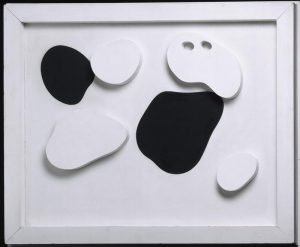
In this Dada work, Configuration with Two Dangerous Points reveals Arp’s strong focus on achieving a perfect structural balance without losing movement. Thus, composed of four white and two black elements, this work exhibits an overt sense of play.
Reference:
The Art Story: Visual Art Movements, Artists, Ideas and Topics
More Articles:
Realist Painter of the Baroque Period: Rembrandt
Dualism and Art about Greek Mythology