Back in the 1970s, going to see a movie involved a short feature before the main showing. Mostly, these were cartoons, but occasionally there would be a documentary. Once such was Animals are Beautiful People from 1974. Controversially, it showed animals getting drunk on fermented fruits and suggested they sought it out for pleasure, in the same way humans do. Needless to say, it was condemned as anthropomorphism, projecting human characteristics onto animals. Strangely enough, there has been a lot of research into animal intoxication. In this month’s paddle through the backwaters of science, let’s take a look at Intoxicated Animals.
Definitions
The definition of Intoxicated, used in this article, is altered behaviour or loss of control while under the influence of alcohol or drugs (Dictionary, 2025). In humans, alcohol intoxication is measured by Blood Alcohol Concentration (BAC). Looking back, my article Detection and Analysis of Drugs lists the various methods by which law enforcement agencies measure the levels of drugs and alcohol in a person’s system.
The body metabolises and excretes the intoxicating element by a variety of methods. For alcohol, the liver is the primary source of elimination, using both the aldehyde dehydrogenase and alcohol dehydrogenase enzymes in this task. BAC and Elimination Rate (ER) of alcohol depends on many factors, such as if food was taken at the same time as the alcohol, or how often the person drinks. Food slows down the rise of BAC, and frequency of drinking slows down the ER (Zakhari, 2006). Many of the findings about alcohol have been uncovered due to research on laboratory animals, so let’s leave humans behind and focus on other Intoxicated Animals.
Drunken Worms
For our first foray into other animals, we look at worms. Researchers at the University of Amsterdam decided to model the movement of active matter polymers by use of worms. They raced drunk versus sober worms through a pillar-array chromatography maze, washed through with water. As you know from previous articles, Chromatography is used to separate out ink colours in forensic analysis, but it can be used in many other ways. Pillar array chromatography is more generally used to separate molecule strands of different lengths and molecular weights, but in this case, researchers decided to use worms to model the molecules’ behaviour. To their surprise, the sober worms won. They had expected the less motile, drunk worm to be washed through first, but the wriggling, sober worms won the match (Institute, 2024).
Fermented Fruit
As I said above, the documentary showing intoxicated animals from 1974 was wildly criticised for inaccuracy. However, more recent research has shown that alcohol consumption among non-human animals is not as rare as was thought. It’s interesting to note that enzymes which metabolise alcohol were present before yeast began to turn flower nectar and fruit into alcohol.
Credit: SaguaroNPS, Public domain, via Wikimedia Commons
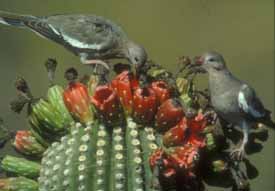
However, evolution optimised this ability in primates and avians that subsist on fruit or nectar. White winged doves are happy to eat fruit from the saguaro cactus, see image 1. The need to quickly degrade the alcohol is vital to prevent inebriation. Intoxication is a quick way to end up on another animal’s dinner menu (Morrison, 2024).
Vienna has a problem with birds flying while intoxicated. Researchers discovered that many of the birds that had broken their necks flying into windows, did so after eating rotting berries. Upon performing a post-mortem examination, analysts found that birds had damaged livers (Muller, 2011). As alcohol is metabolised by the liver, this suggests they regularly consume this type of meal.
Consuming alcohol provides a good source of easy calories. As a volatile liquid, the scent of alcohol travels for miles, luring animals to a good source of food. So, in theory, animals are unlikely to seek intoxication, despite the feel-good endorphin boost alcohol provides, but the smell entices them to dine (Morrison, 2024).
Spiders on LSD
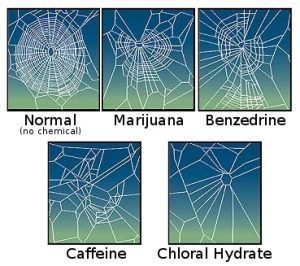
Other experiments show just how intoxicating some substances are. When the UK government wrote new laws on psychoactive drugs, they specifically excluded caffeine. A study by NASA suggests that this may have been unwise. NASA scientists fed flies laced with different psychoactive drugs, including LSD, Marijuana, sleeping pills, Benzedrine and finally caffeine, to spiders. They left the spiders to spin their webs, just to see how toxic the substances were.
With a small dose of caffeine, spiders made much smaller webs, but when the dose was increased, they were unable to create a regular web at all. The spider’s sense of geometry was totally disrupted (NASA, 2032).
Credit: NASA, Public domain, via Wikimedia Commons
For the other drugs, Marijuana disrupted the web formation least, but all drugs deformed the webs to some degree, as shown in image 2. Of course, spider nervous systems are very different from human, so it’s not necessarily a good comparison.
Rats on drugs
What’s needed is mammalian nervous systems. Laboratory tests on rats have told us a lot about humans and morphine addiction. If we return to the 1970s, Dr Bruce Alexander studied drug addiction in rats. He placed individual rats in isolated cages and provided them with three water bottles. One was filled with plain water, one laced with heroine, and the final one doctored with cocaine. In these conditions, the rats chose the drugged bottles over plain water, and fatally overdosed.
From this, one might think that drugs are relentlessly addictive. But Dr Alexander did not stop there. He then placed rats in a Rat Park, among a community of rats, and offered the same water bottles. Mostly, the rats with company chose plain water. Occasionally, they would imbibe the drugs, but not in an addicted, driven way. When they had company, rats did not get addicted to drugs. This goes a long way to explaining why hospitalised people on morphine have no need to take the drugs after they leave medical care, and return to their families. Humans are social animals, just like rats, and if they have a caring supportive society, they are less likely to get addicted (Sederer, 2019).
Caterpillars on cocaine
Does addiction happen in other animals? Not necessarily. The caterpillars of the Eloria noyesi moth feed exclusively on cocaine leaves. A diet of cocaine leaves kills most pests, but not these caterpillars. They are entirely resistant to the drug, due to modified dopamine receptors. Indeed, law enforcement agencies are looking into deliberately seeding illegal plantations with the insect larvae, to destroy the crop (Muller, 2011).
Bats and Hornets that can hold their liquor
Unlike the Viennese birds, bats in South America consume large quantities of fermenting fruit and remain sober, with blood alcohol levels that would cause a human to fail a sobriety test. But testing sober bats, against their drunken companions, researchers found no difference in their ability to fly or use their sonar (Muller, 2011).
Bats are not the only critters that can fly straight while under the influence. We’ve seen that alcohol is an easy form of calories for animals of all kinds, but most find that anything more than 4% ethanol is beyond them. Not so the Oriental Hornet. Given a diet of almost 80% ethanol, these hornets thrived. Researchers found that these insects have multiple copies of a gene producing NADP+ (Nicotinamide adenine dinucleotide phosphate) generally used in cellular respiration, but has an extra function of metabolising alcohol. As Brewer’s Yeast reproduces in the hornet’s intestinal tract, the researchers suggested there is a symbiotic relationship. The wasps transport the yeast from rotting fruit to rotting fruit (Quaglia, 2024).
Rats again
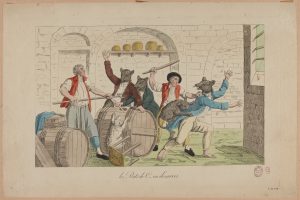
On a final note, if all this intoxication among animals wasn’t enough, Rats are Wine Snobs, reports New Scientist. Looking deeper, an article in Springer Nature, explains how the scientists learned about these party rats, as anthropomorphized in image 3.
Credit: Anonyme, graveur, CC0, via Wikimedia Commons
They were investigating why some humans, with their limited olfactory senses, could distinguish between grape varieties in wine. To do this, they trained other animals, in this case rats with their greater numbers of olfactory senses, to see if they could also perform this task. They learned that not only could the animals tell the difference in varieties, they also tended to prefer one variety over another. The paper concludes by suggesting that humans somehow make up for their lack of nasal receptors by use of language. But still, they turned rats into wine snobs to find this out (Frasnelli, 2025).
References
Frasnelli, E., Chivers, B.D., Smith, B.C. et al. Rats can distinguish (and generalize) among two white wine varieties. Anim Cogn 28, 16 (2025). https://doi.org/10.1007/s10071-025-01937-2
Zakhari S. (2006). Overview: how is alcohol metabolized by the body? Alcohol research & health: the journal of the National Institute on Alcohol Abuse and Alcoholism, 29(4), 245–254.
Dictionary. (2025) Intoxicated. Cambridge University Press & Assessment. https://dictionary.cambridge.org/dictionary/english/intoxicated
Institute of Physics. (2024) Ig Nobel Prize for Drunk Worms. University of Amsterdam. 13 September. https://iop.uva.nl/content/news/2024/09/ig-nobel-prize-for-drunk-worms.html?cb&cb
Morrison, A. (2024). Alcohol Consumption May Not be as Rare as Previously Thought, say Ecologists. University of Exeter. 30 October. https://news.exeter.ac.uk/faculty-of-environment-science-and-economy/alcohol-consumption-among-non-human-animals-may-not-be-as-rare-as-previously-thought-say-ecologists/#:~:text=Anecdotes%20abound%20of%20wildlife%20being,journal%20Trends%20in%20Ecology%20%26%20Evolution
Muller, N. (2011). Animals Getting High: 10 Common Drunks. Australian Geographic. 14 October. https://www.australiangeographic.com.au/topics/wildlife/2011/10/animals-getting-high-10-common-drunks/
NASA Experiment with Spiders and Mind-Altering Drugs. (2023) Mirage. 01 May. https://www.miragenews.com/nasas-experiment-with-spiders-mind-altering-996703/#:~:text=In%20the%20experiment%2C%20caffeine%20led,and%20motor%20skills%20of%20spiders.
Sederer, L. (2019). What does “Rat Park” Teach us about Addiction? Psychiatric Times. 10 June. https://www.psychiatrictimes.com/view/what-does-rat-park-teach-us-about-addiction
Quaglia, S. (2024) Hornets Can Hold Their Alcohol Like No Other Animal On Earth. New Scientist. 21 October. https://www.newscientist.com/article/2452557-hornets-can-hold-their-alcohol-like-no-other-animal-on-earth/