Liko Noe: Zero Energy Building
Zero Energy Building is a building that needs very low amount of energy for heating, cooling, lighting and other consumption and this need is completely supplied from renewable energy sources. It combines the concepts of energy efficiency and renewable energy generation in order to have very low energy needs and to produce the amount of energy all zero energy buildings need by producing them on-site (or away) through renewable sources for a certain period of time. Liko Noe is a zero energy building located in Southern Moravia, near the city of Brno. It was created by Czech architect Zdenánk Fránek in partnership with scientists. It is not the first building Fránek and his studio have built with a team of scientists. However, their aim in this project was to create an innovation center for a family business that would be completely independent of the urban distribution network, based entirely on resources found in nature.

The building can be seen as an exemplary project among ecological approaches to architecture and the working environment. This approach also proves that art and science do not need to exist side by side, but that they can penetrate each other. First, at the birth of the design, there was a determination to cover the maximum amount of ecological criteria. These later became the main topic. In the building, the ecological principle does not stand out from the building in any way and is not displayed in a flashy way. As a result, ecology has become the architecture of the building.
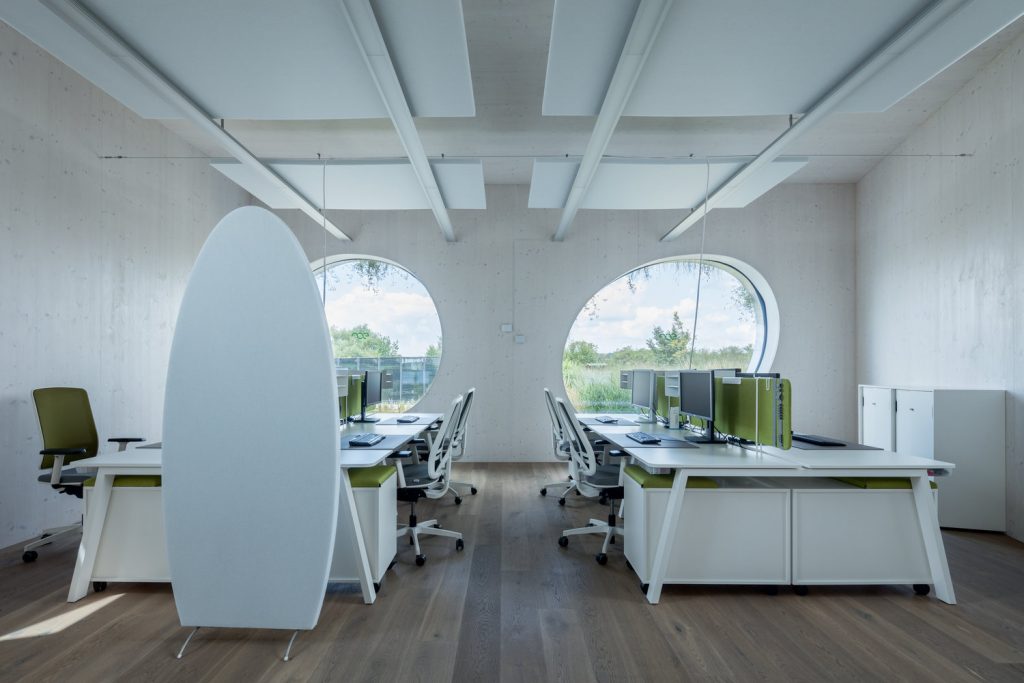
The ship-shaped form of the building refers to Noah’s Ark, which was used as a model during the design process. However, it is mainly focused on the idea of harmonizing and accommodating human and nature. Large, round windows resembling ship windows allow more sunlight to penetrate the inside, minimizing the use of lighting. The façade of the building is almost completely covered by grass that directly contributes to the water supply.

Ecological Advantages of Liko-Noe
- Construction of the building cost 250m2 of meadow but created 352m2 of green space producing 598.4 kg of oxygen per year (1.7 kg/m2/year).
- The area consumes 809.6 kg of carbon dioxide (2.3 kg/m2/year).
- It manages water very efficiently.
- It provides heat stabilization.
- It reduces ambient noise by 8 DB.
Sources;
Liko-Noe – Experimental Structure in Slavkov | Fránek Architects. (n.d.). Archello. Retrieved June 11, 2021, from https://archello.com/project/liko-noe-experimental-structure-in-slavkov
Liko-Noe and Franek Architects’ scientific approach | Floornature. (n.d.). Floornature.com. Retrieved June 11, 2021, from https://www.floornature.com/liko-noe-and-franek-architectsa-scientific-approach-12545/
Karakoç, N. (2019, July 24). Kendine Yeten Bir Bina. Arkitera. https://www.arkitera.com/haber/kendine-yeten-bir-bina/
Specific environmental benefits of LIKO-Noe® | Partitions and movable walls. (2017). Partitions. https://www.liko-partitions.com/en/specific-environmental-benefits-of-liko-noe-reg
Fránek architects. (n.d.). BOYSPLAYNICE Photography & Concept. Retrieved June 11, 2021, from http://www.boysplaynice.com/franek-architects-liko-noe?locale=en